
The 15-minute core routine every cyclist should be doing
The Moveee team
Free coaching · a real route for every ride
Core strength has a bad reputation among cyclists, mostly because it's been sold badly. It isn't about visible abdominals, and it certainly isn't about doing three hundred sit-ups. For a rider, the trunk has one job: stay still and stable while your legs produce force underneath it.
When it can't, three things happen — you leak power sideways, you can't hold an efficient position for long, and your lower back starts complaining somewhere in hour three. Fifteen minutes twice a week fixes most of it.
What a strong trunk actually does for you
Holds your position
Late in a long ride, a weak trunk lets you collapse — shoulders drop, back rounds, breathing gets shallow. A strong one holds the shape you set out with.
Stops power leaking
Every watt travels from your hips through your trunk. If it rocks and twists, some of that force goes sideways instead of into the pedal.
Protects your lower back
Low back pain is one of the most common cycling complaints, and a weak, unsupported trunk under a long-held forward position is a leading cause.
Lets you use the drops
A more aggressive, aerodynamic position is only comfortable if your trunk can support it. Core work buys you positions you couldn't otherwise hold.
The muscles that matter for cycling are the deep abdominals, the obliques down your sides, the lower back, and the glutes. Sit-ups train roughly one of those. That's why the routine below is built almost entirely from anti-movement exercises — holding still against a force — rather than crunching.
The fifteen-minute routine
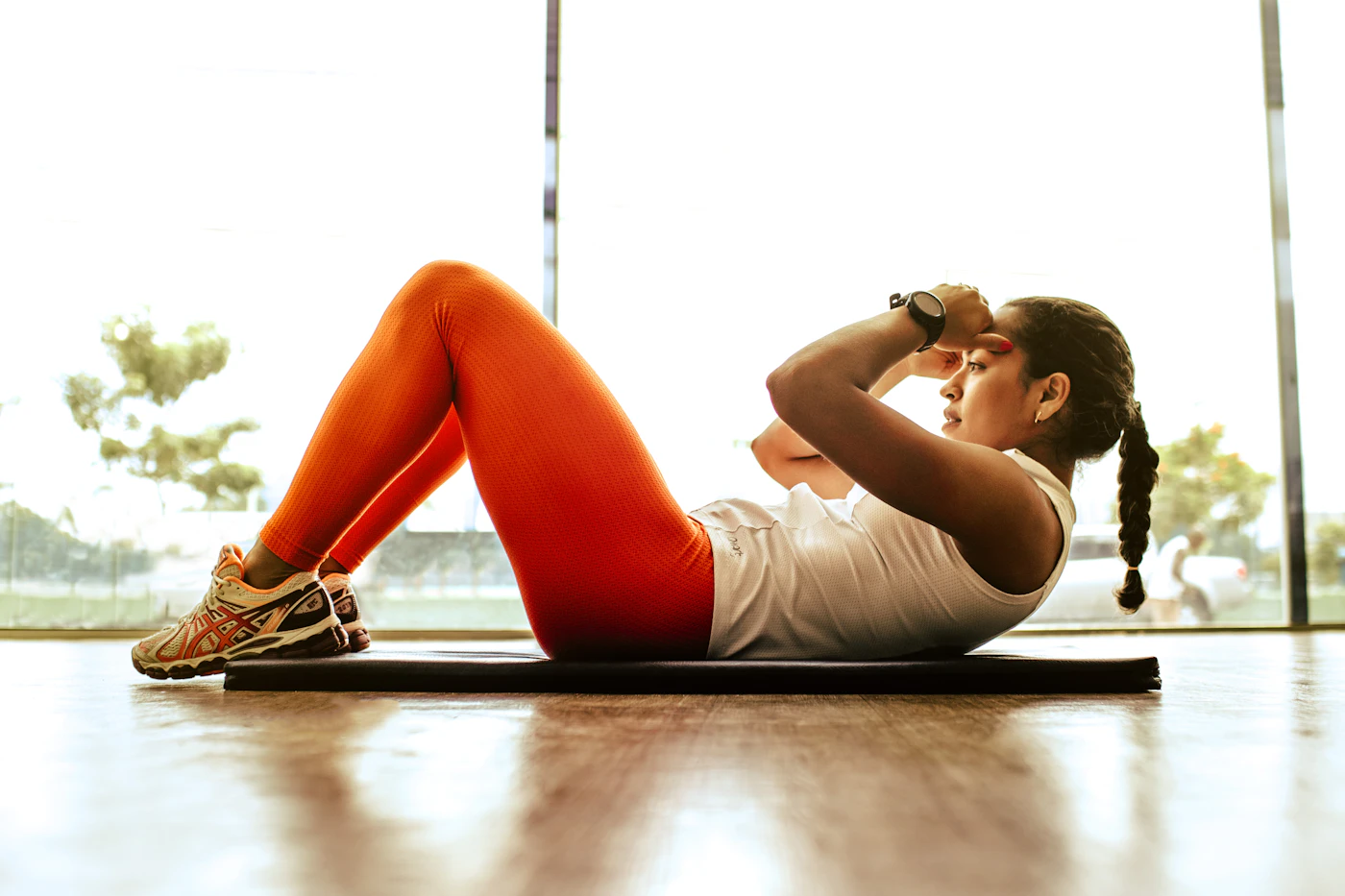
Six exercises, twice a week, no equipment beyond a mat (and a band for the last one). Do them as a circuit with 30 seconds between exercises.
Front plank
3 × 30–60 sSqueeze the glutes, tuck the ribs down, don't let the hips sag. Quality beats duration — stop when the form goes.
Side plank
3 × 20–45 s eachTrains the lateral chain that stops your hips rocking side to side on the bike. Most cyclists are notably weak here.
Dead bug
3 × 8 each sideSlow and controlled. Keep the lower back flat on the floor throughout — if it arches, shorten the range.
Bird dog
3 × 8 each sideOpposite arm and leg. Teaches the trunk to stay still while the limbs move — which is exactly what pedalling asks of it.
Glute bridge
3 × 12Cyclists live in hip flexion and end up with sleepy glutes. This wakes them up and directly supports pedalling force.
Pallof press
3 × 10 each sideAnti-rotation with a band or cable. Resisting twist is the single most cycling-relevant thing a trunk does.

How to fit it in
- Straight after a ride is the easiest habit to build — you're already changed, already warm, and it takes less time than a shower.
- Twice a week is enough. This is maintenance work, not a training block. Three times is fine; five is pointless.
- Never before a hard ride. A fatigued trunk makes a threshold session worse, not better.
- Progress by adding time or difficulty, not by adding more exercises. A 60-second plank with good form beats three minutes of sagging.
The signs you need it
Some fairly reliable tells that your trunk is the weak link:
- Your hips rock noticeably side to side when you push hard — especially visible on a trainer or in a shop window.
- Your lower back aches after two or three hours, before your legs do.
- You can't hold the drops comfortably for more than a few minutes.
- Your shoulders and neck are sore after long rides, because they're compensating for a trunk that isn't holding you up.
It pairs with the gym, not replaces it
Core work is a complement to proper resistance training rather than a substitute for it. If you're only going to do one, do the squats and deadlifts in our guide to strength training for cyclists — big compound lifts train the trunk hard as a side effect. The routine above is what you add on top, and what you fall back on when you can't get to a gym.
And the reason all of this matters at all is that it shows up on the bike. Hold your position better, keep your hips still, stop leaking watts sideways — and the same training produces more speed. If you want the riding half of the equation planned for you, Moveee writes a periodised block around the days you can actually ride, free, learned from your own history. On the days the weather wins, Moveee Indoor puts one of your real routes in front of you in the browser with the session already loaded — and a trainer is, incidentally, the easiest place in the world to notice your hips rocking.
Fifteen minutes, twice a week, for a winter. It's the least exciting recommendation on this blog and one of the few you'll feel within a month.
Sources 4
Where this article summarises a study, the study itself is linked — not a write-up of it.
- 1 Clarsen B, Krosshaug T, Bahr R Overuse Injuries in Professional Road Cyclists · The American Journal of Sports Medicine · 2010
- 2 Streisfeld GM, Bartoszek C, Creran E, Inge B, McShane MD, Johnston T Relationship Between Body Positioning, Muscle Activity, and Spinal Kinematics in Cyclists With and Without Low Back Pain: A Systematic Review · Sports Health · 2017
- 3 Abt JP, Smoliga JM, Brick MJ, Jolly JT, Lephart SM, Fu FH Relationship Between Cycling Mechanics and Core Stability · Journal of Strength and Conditioning Research · 2007
- 4 Rønnestad BR, Mujika I Optimizing strength training for running and cycling endurance performance: A review · Scandinavian Journal of Medicine & Science in Sports · 2014
See this in your own numbers
Moveee builds your power curve, fitness and fatigue from every ride you upload, and writes a training plan around them. It is free, it takes one Strava connection, and it will tell you more about your riding in a week than any article can.
Start freeKeep reading

Why every cyclist should lift weights (and how to start)
Strength work won't make you bulky or slow — it makes you fatigue later, hold position longer and break fewer bones. Six movements, twice a week, and how to fit them around your riding.
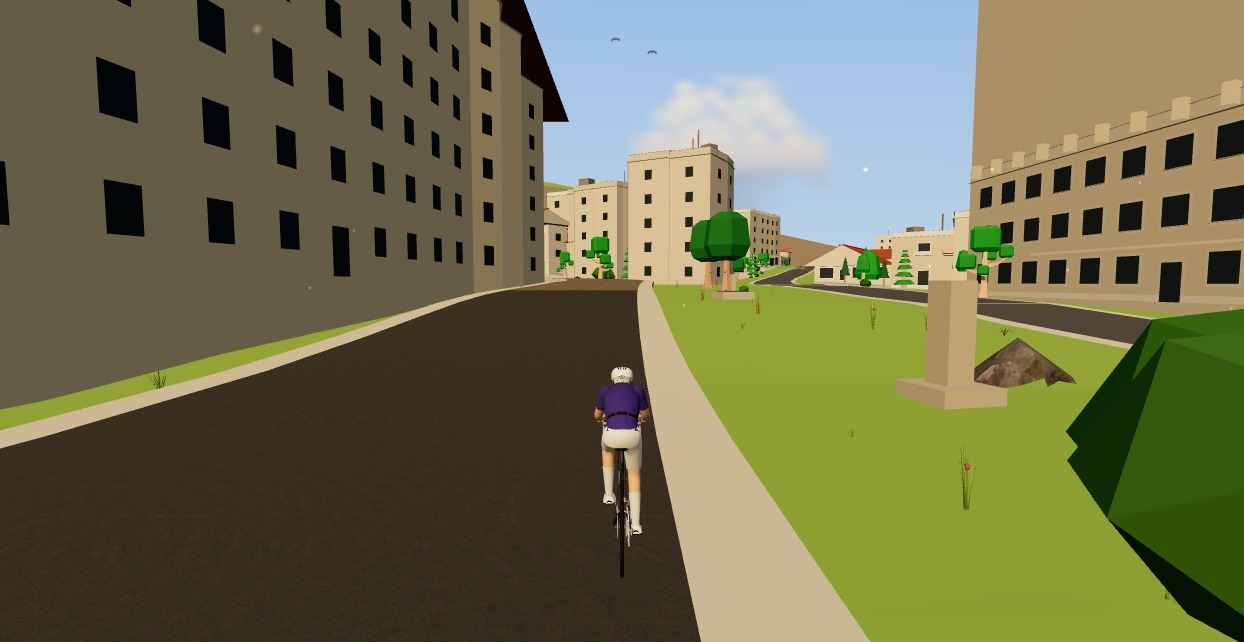
How to train indoors: turning trainer time into real fitness
An hour on the trainer can be worth ninety minutes on the road — or completely wasted. Here's how to structure indoor sessions so every minute you spend in the pain cave counts.

How to test your FTP without a 20-minute test
Ramp tests, eight-minute protocols, critical power from three efforts, or simply reading it off your ride data. How each method works, how far it lands from a true hour of pain, and which suits you.

30/30s: the shortest intervals that still build your ceiling
Thirty seconds hard, thirty seconds easy, twenty times. Microintervals chase the same adaptation as five-minute VO2max efforts by a route most riders can actually finish — provided you get the first three reps right.

Aerobic threshold: the test you can do on any trainer
Three field methods for finding your aerobic threshold without a lab: the talk test, heart-rate drift over a steady hour, and DFA alpha 1. What each is validated against and how far to trust it.
Lifting and riding in the same week: the interference effect, honestly
The molecular argument against doing both sounds decisive and mostly fails to show up in trained cyclists. Which direction the interference actually runs, how much separation matters, and a weekly template that stops the two from fighting.
Your FTP went down. Six reasons, and only one of them is fitness
Same trainer, same test, twelve watts lower. Before you rewrite the plan: a lower test result usually is not lost fitness. The six causes in order of how often they turn out to be the answer, and the five-minute check that tells you which.

Detraining: how fast you lose fitness (and how fast it comes back)
Two weeks off costs less than most riders fear, and eight weeks costs more than they hope. A week-by-week look at what actually declines — blood volume, enzymes, muscle — and how quickly it returns.
Repeated sprint ability: why the fifth effort is the one that matters
Nobody wins a race on their first sprint. What determines how little you lose across repeated maximal efforts, why the answer is largely aerobic, and how to train the thing that lets a sprinter sprint twice.

FTP explained: what it is, how to test it, and how to actually raise it
FTP is the single most useful number in cycling — it sets your zones, tracks your fitness and shapes every workout. Here's what it means, how to measure it, and how to push it higher.
Ramp rate: how fast you can add training load without breaking
Every rider who discovers load tracking tries to make the number go up as fast as possible, and a few weeks later is ill. The conventional bands, what actually sets your own limit, and why a build that never comes down is not a build.

Lower back pain on the bike: what's actually causing it
Usually a position your hips and hamstrings can't hold, rather than a back problem. How reach and drop interact with mobility, what core endurance research supports, and how to tell position pain from something else.