How to train indoors: turning trainer time into real fitness
The Moveee team
Free coaching · a real route for every ride
The single biggest advantage of indoor training is that nothing interrupts it. No junctions, no traffic lights, no descents where you stop pedalling, no headwind that turns your tempo effort into a threshold effort. That means an indoor hour can contain far more genuine time-in-zone than an outdoor hour — which is exactly why it's so effective, and exactly why it's so easy to waste.
Wasted indoor time looks like this: you clip in, ride at a vague "quite hard" for 50 minutes, get hot, get bored, get off. You've accumulated fatigue but no clear training stimulus. Here's how to make sure that never happens.
The first rule: one job per session
Every indoor session should have exactly one purpose you could state in a sentence. "Today is VO2 max." "Today is sweet spot." "Today is easy." When a session tries to do everything — some hard efforts, some tempo, a bit of sprinting — it ends up doing nothing particularly well, and it costs you the same recovery as a session that did.
Pick the quality, build the session around it, and let everything else be support.
The anatomy of a good indoor hour
10–15 min · 55–65% FTP
Indoors you're cold and stiff — there's no rolling out of the driveway. Include 2–3 short 30-second lifts to open the legs before the real work.
20–40 min · Session-specific
The reason you're here. Everything else exists to protect this block. Keep it focused on one quality — don't mix VO2 and sweet spot in the same hour.
Built in · 45–55% FTP
Actually pedal easy — don't stop. Spinning keeps blood moving and makes the next rep possible. Coming to a halt indoors is the fastest way to a cold, stiff second half.
5–10 min · 45–55% FTP
Five minutes of easy spinning clears the legs and stops the room-spins. Skipping it is how a good session ends with you slumped over the bars.
Notice that the main set is only 20–40 minutes of a 60–75 minute session. That's correct. The quality of those minutes is what makes you faster; the rest is scaffolding.
How much indoor riding is enough?
Two hard indoor sessions a week, done properly, will move almost any amateur's fitness. Three is plenty. More than that and you're usually accumulating fatigue faster than you're absorbing it — especially because indoor riding is so relentless.
A very common and very effective week looks like this:
VO2 max or threshold. 60 min. The hardest thing you do all week.
Sweet spot or over-unders. 60–75 min. Sub-threshold, high-value work.
2–4 hr endurance. Outside if you can; indoors with company or a film if you can't.
45–60 min genuinely easy. Z1–low Z2. Recovery, not secret training.
Three days off the bike entirely. That's not laziness — it's what lets the two hard sessions be genuinely hard. See recovery is training for why this matters more than the sessions themselves.
Six mistakes almost everyone makes
1 Riding every session at 'medium'
Make hard days hard and easy days genuinely easy. The grey zone in between builds fatigue without building fitness.
2 No fan, or a token one
Heat is the limiter indoors, not your legs. Get a proper fan pointed at your chest and face before you buy anything else.
3 Training to your outdoor FTP
Most riders produce less power indoors. Test indoors, or set your indoor targets a little lower.
4 Two-hour sessions to feel virtuous
Indoor time is concentrated. 60 focused minutes beats 120 distracted ones, and you'll still be willing to come back on Thursday.
5 Skipping the cool-down
Five easy minutes. It costs nothing and makes the rest of your evening — and tomorrow — better.
6 Never leaving ERG mode
ERG is superb for steady intervals but it dulls your feel for pace. Ride some sessions in slope mode and pace them yourself.
Make the hour disappear
The last piece is psychological, and it's not a soft one — a session you dread is a session you'll skip. Two things reliably help. First, know exactly what's coming: a session with a visible structure ("4 × 8 minutes, three done, one to go") is far easier than an open-ended "ride hard for an hour." Second, have something to look at that isn't a wall.
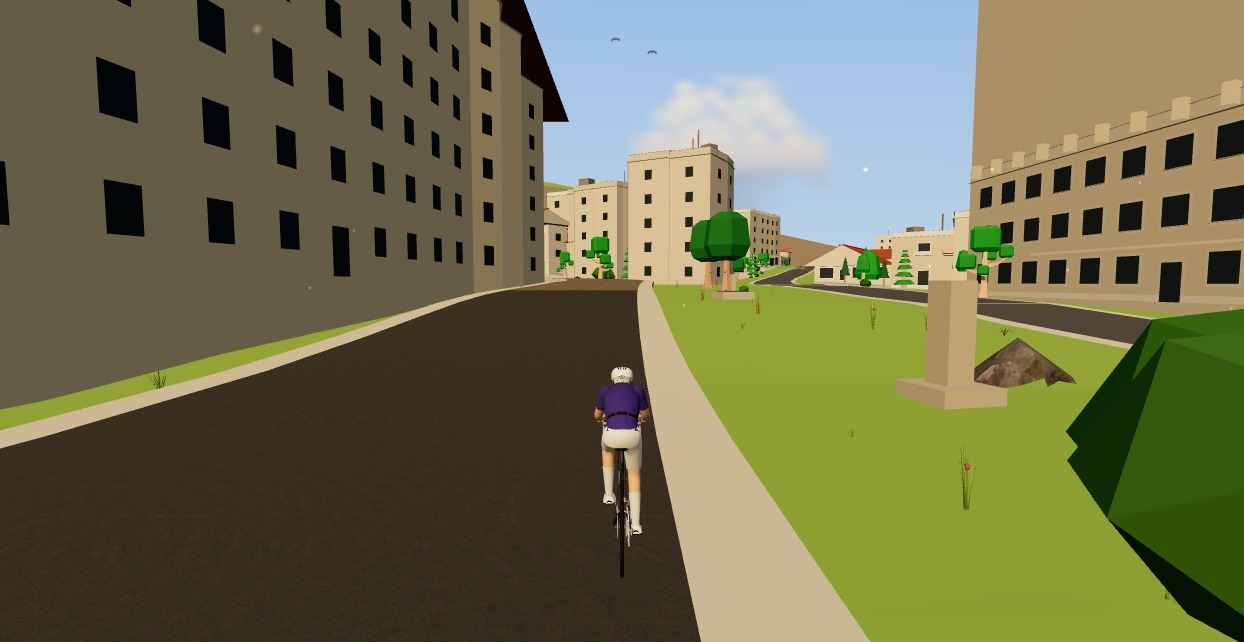
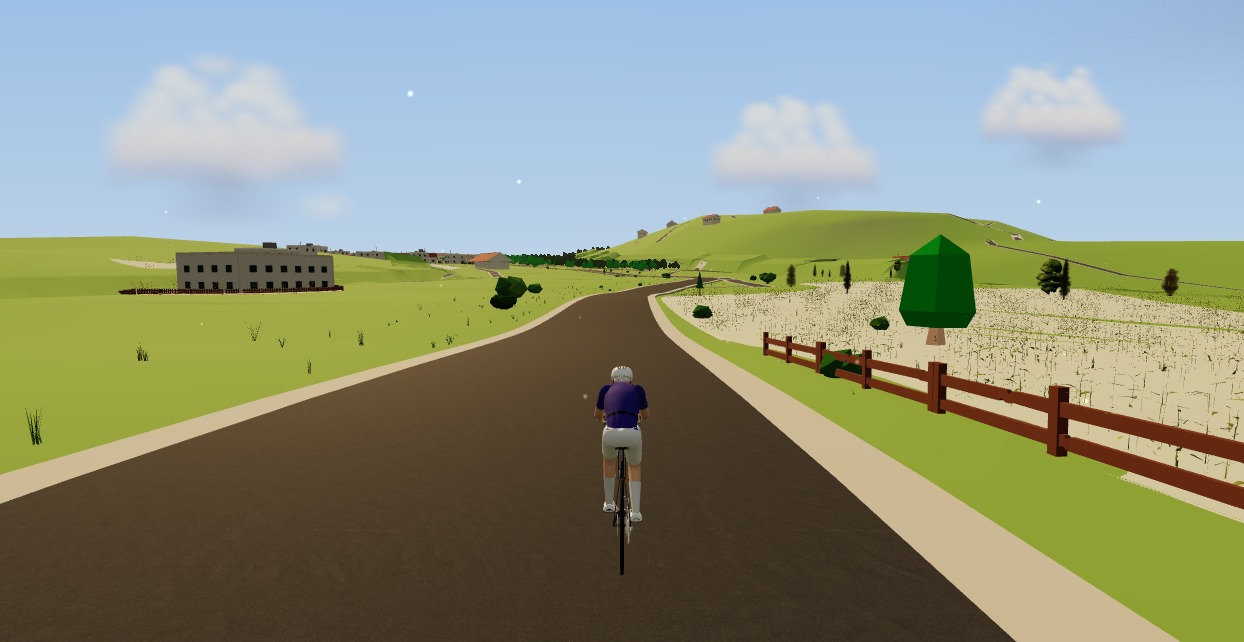
That second point is where virtual worlds earn their keep. Moveee Indoor takes a different angle to most: instead of a fictional island, it builds the world from your own routes and real map data, so you can ride the roads of your actual summer loop — or recon next season's target event — while the trainer holds your intervals in ERG mode. It runs in the browser with nothing to install, and it's free while in alpha.
However you fill the screen, the training principles don't change: one job per session, hard days hard, easy days easy, a fan on full, and a plan you can see the end of. Do that twice a week through a winter and you'll be a noticeably different rider by spring. If you'd rather not write the sessions yourself, Moveee builds the whole plan around the days you actually ride — free, and it learns your engine from your own history.
Sources 6
Where this article summarises a study, the study itself is linked — not a write-up of it.
- 1 Mieras ME, Heesch MWS, Slivka DR Physiological and psychological responses to outdoor vs. laboratory cycling · Journal of Strength and Conditioning Research · 2014
- 2 Périard JD, Eijsvogels TMH, Daanen HAM Exercise under heat stress: thermoregulation, hydration, performance implications, and mitigation strategies · Physiological Reviews · 2021
- 3 Saunders AG, Dugas JP, Tucker R, Lambert MI, Noakes TD The effects of different air velocities on heat storage and body temperature in humans cycling in a hot, humid environment · Acta Physiologica Scandinavica · 2005
- 4 Seiler S What is best practice for training intensity and duration distribution in endurance athletes? · International Journal of Sports Physiology and Performance · 2010
- 5 McGowan CJ, Pyne DB, Thompson KG, Rattray B Warm-up strategies for sport and exercise: mechanisms and applications · Sports Medicine · 2015
- 6 Menzies P, Menzies C, McIntyre L, Paterson P, Wilson J, Kemi OJ Blood lactate clearance during active recovery after an intense running bout depends on the intensity of the active recovery · Journal of Sports Sciences · 2010
Your own roads, indoors, in a browser tab
Moveee Indoor pairs your smart trainer over Bluetooth and rebuilds a route you have saved as a 3D road — real gradients, ERG for the intervals, and the ride saved with full power data. Nothing to install. Free while it is in alpha.
Start an indoor rideKeep reading

Indoor training with heart rate only (no power meter, no problem)
No power meter, no smart trainer — just a heart-rate strap? You can still train properly. How to find your threshold heart rate with one honest 30-minute test, set five zones from it, structure a week around what HR measures well, and work around what it doesn't (lag, drift and hot rooms).

How to build a cycling training plan around a full-time job
You don't need 12-hour weeks to get properly fast — you need the right 6–8 hours, placed where your life can actually hold them. Here's how to anchor a working week around two quality sessions and one long ride, what to cut first when work explodes, and why a plan that adapts beats a plan that's perfect.

What your power curve says about you: sprinter, puncheur or diesel?
Your best 5 seconds, 1 minute, 5 minutes and 20 minutes tell a story your FTP alone can't: what kind of rider you actually are. How to read your own power-duration curve, the signature shapes of sprinters, puncheurs, diesels and climbers — and when to train your weakness versus doubling down on your strength.

Heat training indoors: the performance boost hiding in your pain cave
Your trainer room is accidentally a heat chamber — and used deliberately, carefully and only on easy days, heat adaptation can raise plasma volume and buy trained riders a real aerobic bump. The protocols, the schedule before a hot event, and the safety rules that are not optional.

Morning or evening: does the time you train change what you get?
Peak power really is higher in the late afternoon, and the effect is much smaller than the effect of actually doing the session. What circadian rhythm does to performance, and why the honest answer is "whenever you will keep turning up".

How to test your FTP without a 20-minute test
Ramp tests, eight-minute protocols, critical power from three efforts, or simply reading it off your ride data. How each method works, how far it lands from a true hour of pain, and which suits you.

The 15-minute core routine every cyclist should be doing
A strong trunk stops your hips rocking, stops power leaking sideways and keeps your lower back quiet in hour three. Six exercises, no equipment, twice a week.

Cycling cadence: does it actually matter? What the science says
The internet is full of one true cadence — the research says your legs already found theirs. What the science honestly shows about self-selected cadence, when deliberate high or low RPM work genuinely helps, the typical ranges by situation, and the drills worth folding into an easy hour.

Four hours a week: the most fitness you can get from very little time
At four hours a week the 80/20 rule stops applying and two well-chosen interval sessions do most of the work. What the low-volume studies found, and a week that fits.

Cooling down and stretching: what actually helps, honestly
The evidence is far less conclusive than the folklore. Here's what a cool-down genuinely does, what stretching is and isn't good for, and the six stretches worth ten minutes after a ride.
Why your indoor FTP is lower (and what to do about it)
Most riders push noticeably less power indoors than out. Heat is the main culprit — here's the physiology, how big the gap usually is, and how to close most of it.

Everesting indoors: how to climb 8,848 m without leaving your pain cave
One climb, repeated until you've ascended the height of Everest — indoors, where there's no weather, no traffic, and absolutely nowhere to hide. The gradient maths, the pacing (it's an eating contest with pedalling attached), the two-fan setup, and the fitness you honestly need before you try.