The Moveee team
Free coaching · a real route for every ride
A gran fondo is the purest pacing test in amateur cycling. There is no team, no tactics worth the name, and — for almost everyone — no realistic prospect of winning. What there is, is five or six hours in which you can either ride within yourself and finish strong, or spend twenty minutes feeling like a hero and four hours paying for it.
Power makes that decision objective. It does not make it easy, because the hard part happens in the first hour when everything feels wonderful.
Why a number beats feel
Perceived effort is an unreliable pacing instrument early in a long event. Adrenaline, a fresh body, company and the occasion all conspire to make 85% of FTP feel like 70%. By the time it feels like 85%, you have already spent something you cannot get back.
A power target does not care about any of that. It is a promise you made to yourself in a calm room, and its whole value is that it is inconvenient at the moment you most want to ignore it.
Choosing the number
The longer the event, the lower the fraction of FTP you can hold. These are starting bands for a rider with a current, honest FTP — if yours is a year old or was set on a good day, start at the bottom of the range.
| Expected time | Steady ground | Climbs |
|---|---|---|
| Under 3 hours Short enough that you can afford to bleed into threshold on the final climb. |
76–82% of FTP | Up to 95% on the longest climb |
| 3–5 hours The classic fondo. This is where the discipline matters most, because you feel wonderful for the first two hours. |
68–75% of FTP | 85–90% on climbs, never more |
| 5–7 hours Now durability is the limiter, not threshold. Fuelling decides more of your result than pacing does. |
60–68% of FTP | Around 80% on climbs |
| Over 7 hours Almost entirely an eating and pacing exercise. Any effort you make above the plan will be repaid with interest. |
55–65% of FTP | Barely above steady |
The four rules that decide the day
You are fresh, the crowd is thick, and riders around you are going far too hard. Whatever number you settle on, the first climb is the one where you must ride below it, not at it.
Chasing a wheel uphill costs far more than the shelter is worth — there is almost no draft at climbing speeds. Chase on the flat, where the draft is real, and ride your own number uphill.
The mirror image. Twenty seconds above target to regain a wheel on a flat road can save you half an hour of solo riding. This is the one place where going over the plan is correct.
Thirty short surges at 130% of FTP will wreck you while leaving your average perfectly respectable. The number that ruins fondos is rarely the average — it is the count of unnecessary efforts.
The last of those is the most commonly missed. Riders review a fondo power file, see a sensible average, and cannot understand why they fell apart. The answer is usually in the surges: every acceleration out of a village, every jump to hold a wheel, every short steep ramp taken out of the saddle. Individually trivial, collectively decisive — which is the practical meaning of W′ and anaerobic capacity.

Build the plan before the day
Look at the route profile in advance and decide, climb by climb, what each one is worth. A long steady 8% climb at hour two is ridden at your climbing number and no more. A short sharp ramp at hour five may be worth going over the plan for, because the recovery afterwards is a descent.
Write it down. Three or four numbers on a strip of tape on your stem is a surprisingly effective way of keeping a promise you will badly want to break. How to pace a climb with power covers the within-climb detail — and be sceptical of the profile itself, which compresses horizontally and will make a long steady drag look like a wall.
Fuelling is half the pacing plan
Pacing and fuelling are not separate problems. A perfectly paced rider who ate nothing will blow up on schedule anyway; an over-paced rider who ate well will merely have a hard last hour rather than a catastrophic one. For an event over three hours, 60–90 g of carbohydrate an hour from the first hour is the framework — fuelling long rides and race day nutrition hour by hour have the practical versions, and what a bonk actually is covers what you are avoiding.
Rehearse it
The plan is worth very little if the first time you ride five hours at 70% of FTP is on event day. Do at least two long rides at close to target pace in the build-up — on the same terrain type if you can — and use them to test the food as well as the number. Durability explains why those rides matter more than another interval session.
Moveee will build the plan around your event date and keep the long rides where they belong in the weeks before it — point it at your fondo and it works backwards from there. And afterwards, the power file will tell you exactly which climb you spent the day on. It is usually the first one.
Sources 6
Where this article summarises a study, the study itself is linked — not a write-up of it.
- 1 Abbiss CR, Laursen PB Describing and Understanding Pacing Strategies during Athletic Competition · Sports Medicine · 2008
- 2 Jeukendrup A A Step Towards Personalized Sports Nutrition: Carbohydrate Intake During Exercise · Sports Medicine · 2014
- 3 Blocken B, van Druenen T, Toparlar Y, et al. Aerodynamic drag in cycling pelotons: New insights by CFD simulation and wind tunnel testing · Journal of Wind Engineering and Industrial Aerodynamics · 2018
- 4 Jones AM, Vanhatalo A, Burnley M, Morton RH, Poole DC Critical Power: Implications for Determination of VO2max and Exercise Tolerance · Medicine & Science in Sports & Exercise · 2010
- 5 Maunder E, Seiler S, Mildenhall MJ, Kilding AE, Plews DJ The Importance of 'Durability' in the Physiological Profiling of Endurance Athletes · Sports Medicine · 2021
- 6 Borszcz FK, Tramontin AF, Bossi AH, Carminatti LJ, Costa VP Functional Threshold Power in Cyclists: Validity of the Concept and Physiological Responses · International Journal of Sports Medicine · 2018
Build a route that is actually worth riding
The Route Engine works from real surface and elevation data and favours quiet roads, so it finds the lanes a fastest-way-there app routes you straight past. Give it a distance and a direction and it does the rest.
Build a routeKeep reading

How to pace a time trial with power
The first two minutes decide most time trials, and usually badly. How to pick a target, why even pacing wins on flat courses but not hilly ones, and how to spend your energy above threshold deliberately.

The first 48 hours after a big event: recovery that speeds up the next one
Eat promptly, eat again, drink more than you lost, sleep twice. What the evidence supports in the two days after a gran fondo, and the ice bath, beer and Monday ride that undo it.

How to train for your first gran fondo (a 12-week plan you can actually follow)
A gran fondo is a long day in the saddle — but it's very doable with the right build. Here's a realistic 12-week plan, the key workouts, and how to pace and fuel the big day.

How to build a sprint that actually wins things
Almost every race finishes in a scramble, and the sprint is the least-trained quality in amateur cycling. The four phases, five sessions, and the recovery mistake that ruins most of them.

Hill climb events: eight minutes of honesty
One road, one clock, nowhere to hide — and the one event where power-to-weight genuinely dominates. Pacing by duration, what is worth stripping off the bike and what absolutely is not, and the warm-up mistake half the field makes.
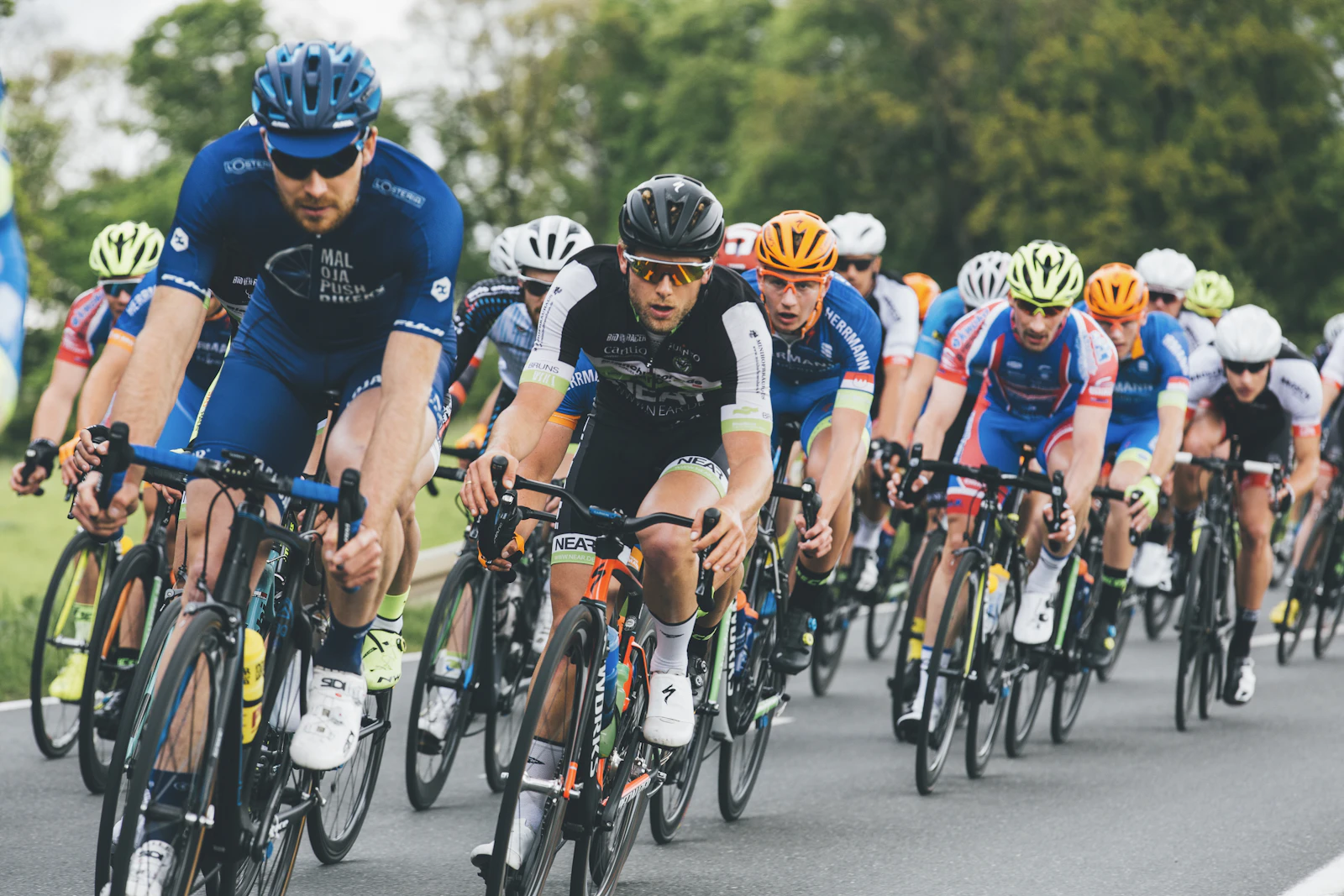
Your first criterium: position, corners and the accordion effect
A crit's average power is often below your FTP, which tells you nothing. What actually decides your first one is where you sit in the bunch — and why the rider at the back is doing a completely different race at the same speed.

Ultra-distance racing: sleep, pacing and the first 24 hours
Past about a day, the limiter stops being your legs. Sleep strategy and what deprivation actually costs you, pacing far below threshold, and the saddle and nerve problems that end more ultras than fitness ever does.

Your first track session: the boards, the fixed gear and the rules
No brakes, no freewheel, and a line painted on the boards that decides where you are allowed to ride. What an accreditation session involves, the two road-rider habits that catch everyone out, and why the banking holds you up.
Everesting indoors: how to climb 8,848 m without leaving your pain cave
One climb, repeated until you've ascended the height of Everest — indoors, where there's no weather, no traffic, and absolutely nowhere to hide. The gradient maths, the pacing (it's an eating contest with pedalling attached), the two-fan setup, and the fitness you honestly need before you try.

Racing in the heat: pace it differently or pay for it
Riders rebuild a training plan over a 3% change in threshold, then ride a 34°C event on their April pacing plan. What heat does to your engine, which cooling tricks are worth doing, and the signs that mean stop immediately.

Your first century: 100 miles, and how to arrive with legs left
Build the long ride to about 120 km, ride the first two hours slower than feels necessary, eat from the first hour and sit in the group. A race-prep guide to 161 km that finishes well rather than merely finishes.
Slovenia's sportives and gran fondos: Maratona Franja and the events worth a trip
Maraton Franja, Juriš na Vršič, L'Étape Slovenia, Alpe Gran Fondo and the Poli maraton: 2026 dates, distances and climbs from the organisers, and an honest view of which to travel for