The Moveee team
Free coaching · a real route for every ride
The bike leg of a triathlon is the only one of the three where you can go faster by holding back. Swim too hard and you lose a little on the bike. Ride too hard and you lose a lot on the run, because the run is where the bill for the whole day arrives. The short answer to "how hard should I ride?" is: hard enough that the bike split is respectable, steady enough that the first two kilometres of the run feel like running rather than survival. What follows is how to find that line for your distance, and why the answer changes completely when drafting is allowed.
The run pays for everything
Cycling and running load the body differently. Running is weight-bearing and eccentric, cycling is neither, and the switch from one to the other imposes its own cost: leg muscles are asked to do something new while blood flow, breathing and posture are still arranged for the bike. Millet, Vleck and Bentley's review of the cycle–run transition lays this out in detail, and the practical upshot is that running form after a hard bike is worse than running form fresh, and stays worse for longer the harder the bike was. Etxebarria and colleagues showed the same thing from the other direction: a lab assessment of a triathlete's running done fresh does not reproduce what they can actually run after a triathlon-specific bike.
So the question is not "what is my best bike split?" but "what is the fastest bike split I can produce that does not ruin the run?" Those are different numbers, and the gap between them grows with distance.
Steady or surging: the evidence is split
The obvious advice is to ride at even power. The evidence is less tidy than that. Suriano and colleagues had triathletes cycle for 30 minutes at either constant or variable intensity, matched for average, then run to exhaustion; the variable-intensity group actually ran for longer. Bernard's group ran a similar design over an hour, with power swinging between 40% and 140% of maximal aerobic power against a constant 65%, followed by a 9.3 km run: the run was 42 seconds slower after the variable ride, with higher lactate and breathing at the start of the run.
The two studies do not contradict each other as much as they seem to. The first used short bouts and a run to exhaustion; the second used a longer ride with much bigger swings and a timed run over a real distance. The reading we take from them is this: a little variation in power costs nothing and may even loosen the legs, but large surges well above threshold, sustained over a long ride, arrive on the run as a slower pace. The longer the bike, the more the second study applies.
Draft-legal racing is a different sport
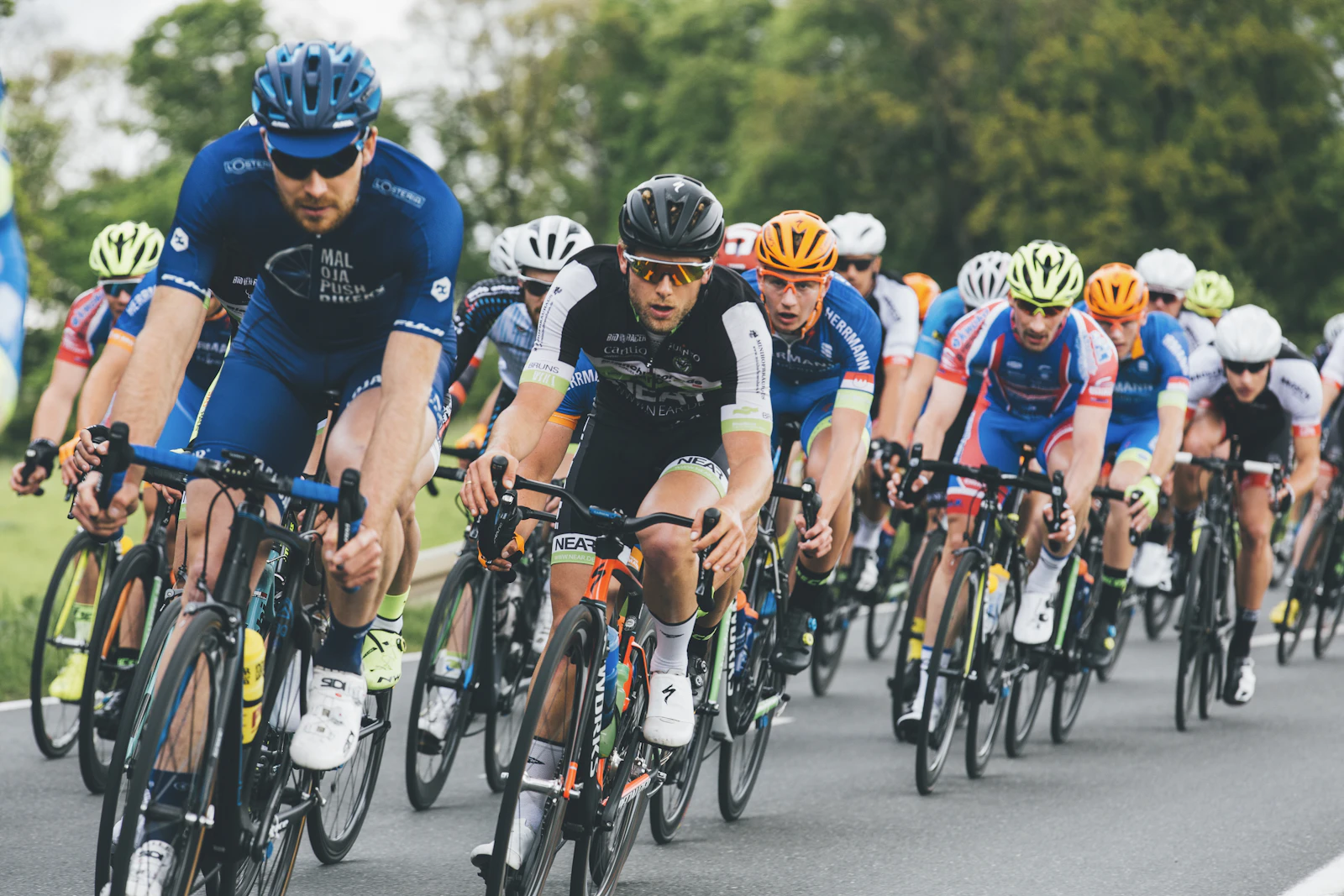
In Olympic-distance and sprint racing where drafting is legal, none of the steady-state advice survives contact with the race. Bernard's analysis of a World Cup bike leg found power was highly variable, with repeated efforts above maximal aerobic power out of corners and on climbs, and Etxebarria's study of international Olympic-distance racing found the same: the bike is a series of surges, not a time trial. You cannot choose to ride evenly, because the pack does not.
What you can choose is where the surges come from. Hausswirth's study of drafting modalities is the useful one here: triathletes who sat continuously behind a lead rider spent less energy on the bike and ran better afterwards than those who alternated the lead. Sitting in, staying out of the wind, and refusing to do a share of the work is not bad manners in a draft-legal race; it is the whole point. Save your surges for staying in the group when it accelerates, not for pulling it along.
- Sprint and Olympic, draft-legal. Ride for position, sit in, and treat every surge as a debt the run will collect. Practise the surge-and-settle pattern in training so the first one in the race is not a shock.
- Olympic, non-drafting. This is closest to a time trial. Even power near your one-hour capability, minus whatever margin the run needs. Most riders find that margin is larger than they hoped.
- Half and full distance. Steady, and well below threshold. The run is long enough that any over-spend on the bike is paid back with interest, and Laursen and Rhodes' review of ultra-endurance triathlon makes clear that fuelling and heat, not power, are usually what decide the last hours.
Picking a number
The usual coaching conventions for long-course bike legs are something like 65–75% of FTP for a full distance and 75–85% for a half, with the lower end for first-timers and the upper for experienced athletes with a proven run. These are conventions from practice rather than findings from a trial, and we would treat them as a starting point to be adjusted from your own race history. Two things are worth checking against them:
- Your FTP has to be honest. A stale or optimistic FTP turns "75%" into something closer to 85%. If yours is a guess, the Power Profile fits a Critical Power curve to your ride data and gives an estimated FTP alongside the one you set, which is a useful sanity check before a race where the number matters.
- Percent of FTP is not the same as percent of effort. Wu and colleagues' review of pacing in triathlon lists heat, hydration, course and prior swim as things that shift the sustainable intensity on the day. On a hot course, the same wattage costs more. Pace by power but let heart rate and breathing overrule it if they drift.
Hills, wind and the temptation to push
On a solo bike leg, the mathematically optimal way to ride hills is to push slightly harder on the way up and ease on the way down, because time lost on climbs is not recovered on descents. That is true for a time trial and we have written about it in how to pace a time trial with power. In a triathlon the same logic holds, but the run tightens the limits: a climb ridden 10% over target is a small gain on the bike and a real loss on the run. Cap the climbs at your target plus a modest margin, and never at threshold. Let the descents be genuine recovery rather than a place to chase a number.
Cadence in the last kilometres
A widely repeated tip is to spin a high cadence in the final minutes of the bike to "prepare the legs" for running. Bernard's group tested it, with triathletes riding the last part of the bike at 60, 80 or 100 rpm before a 3 km run. The cadence made little difference to the run time overall; a higher cadence changed the opening few hundred metres slightly, but the effect washed out. Ride the cadence you are efficient at, and do not manufacture a change for the sake of it. If anything, the more useful preparation in the last kilometres is to stop riding hard, take on the last of your bike fuel, and get out of the aero position early enough that your back and hip flexors have unloaded before the dismount.
The swim sets the bike up
It is easy to think of the bike in isolation, but Peeling, Bishop and Landers showed that swimming at a little below time-trial intensity, rather than flat out, produced a faster subsequent bike and a faster overall triathlon. The swim is a small share of the race and the least efficient place to buy time. Arriving at T1 with something left is a pacing decision for the bike as much as for the water.
Training the pattern, not just the power
The run after a hard bike is a skill and it can be trained. Brick sessions, where a bike is followed straight away by a run, teach the specific discomfort and let you find out what a given bike intensity does to your running before race day tells you. The bike part of a brick is one of the few sessions where a smart trainer is genuinely convenient: a fixed intensity is easy to hold in ERG mode, there is no traffic on the transition, and the run starts at your front door. Moveee Indoor runs in a browser and pairs with FTMS trainers, so a steady 40 minutes at race wattage followed by a 20-minute run needs no more setup than opening a tab.
If you are building towards a specific event, the plan wizard takes a race date and works backwards; it plans the bike, and you add the run and swim around it. It will not model the three disciplines together, and we would rather say that plainly than pretend otherwise.
Two mistakes we see most
- Riding the first 20 minutes on adrenaline. Out of the water, heart rate is high, the legs feel fresh, and the power meter shows a number you would never hold in training. Ride the first quarter of the bike deliberately below target; the average will come up on its own.
- Judging the bike by the bike split. A slower split with a faster run is, in almost every case, a faster race. Compare the whole day, not the leg.
The bike is the longest leg and the one with the most numbers, which is why it attracts the most attention. Give it the attention, then ride it a little more gently than the numbers suggest. The run will tell you whether you got it right, and it is an honest judge.
Sources 8
Where this article summarises a study, the study itself is linked — not a write-up of it.
- 1 Millet GP, Vleck VE, Bentley DJ Physiological differences between cycling and running: lessons from triathletes · Sports Medicine · 2009
- 2 Etxebarria N, Hunt J, Ingham S, Ferguson R Physiological assessment of isolated running does not directly replicate running capacity after triathlon-specific cycling · Journal of Sports Sciences · 2013
- 3 Suriano R, Vercruyssen F, Bishop D, Brisswalter J Variable power output during cycling improves subsequent treadmill run time to exhaustion · Journal of Science and Medicine in Sport · 2007
- 4 Bernard T, Vercruyssen F, Mazure C, Gorce P, Hausswirth C, Brisswalter J Constant versus variable-intensity during cycling: effects on subsequent running performance · European Journal of Applied Physiology · 2007
- 5 Bernard T, Hausswirth C, Le Meur Y, Bignet F, Dorel S, Brisswalter J Distribution of power output during the cycling stage of a Triathlon World Cup · Medicine & Science in Sports & Exercise · 2009
- 6 Hausswirth C, Vallier JM, Lehenaff D, Brisswalter J, Smith D, Millet G, Dreano P Effect of two drafting modalities in cycling on running performance · Medicine & Science in Sports & Exercise · 2001
- 7 Peeling P, Bishop D, Landers G Effect of swimming intensity on subsequent cycling and overall triathlon performance · British Journal of Sports Medicine · 2005
- 8 Wu SS, Peiffer JJ, Brisswalter J, Nosaka K, Abbiss CR Factors influencing pacing in triathlon · Open Access Journal of Sports Medicine · 2014
Plan backwards from your event
Give Moveee your event date and it works back from it — the long rides where they belong, the sharpening in the right week, and a taper that arrives on time. It adapts when you miss a session, because you will.
Plan my eventKeep reading

How to pace a time trial with power
The first two minutes decide most time trials, and usually badly. How to pick a target, why even pacing wins on flat courses but not hilly ones, and how to spend your energy above threshold deliberately.

Ultra-distance racing: sleep, pacing and the first 24 hours
Past about a day, the limiter stops being your legs. Sleep strategy and what deprivation actually costs you, pacing far below threshold, and the saddle and nerve problems that end more ultras than fitness ever does.

Cornering under pressure: the racing lines nobody practises
A bad corner costs you twice: once in it, again on the exit. The physics of lean and grip, where to look, how to countersteer on purpose, and the race-day corners you can only learn by doing.

After the crash: what to check, when to ride again
Head first, then neck, then everything else. What the concussion consensus, the UCI protocol and the fracture literature say about getting back on the bike, and why a doctor decides.

Racing in the cold and wet: staying warm enough to still be racing
Cold rain ends races for riders who were fit enough to finish them, and it usually does it on the descent rather than the climb. Losing your hands before you lose your legs, and the clothing decisions that are really race decisions.

How to ride a hilly sportive you're underprepared for
Four weeks out and short of training? The fitness is what it is — but pacing, gearing and fuelling are all still in play, and together they matter more on the day than the training you didn't do.

Racing in the heat: pace it differently or pay for it
Riders rebuild a training plan over a 3% change in threshold, then ride a 34°C event on their April pacing plan. What heat does to your engine, which cooling tricks are worth doing, and the signs that mean stop immediately.

Hill climb events: eight minutes of honesty
One road, one clock, nowhere to hide — and the one event where power-to-weight genuinely dominates. Pacing by duration, what is worth stripping off the bike and what absolutely is not, and the warm-up mistake half the field makes.
Pacing a gran fondo with power: the first climb is the trap
The purest pacing test in amateur cycling. Target bands by event length, the four rules that decide the day, and why the number that ruins fondos is almost never the average.
How to peak twice in one season
A taper buys you a window of a couple of weeks, not a summer. How long a peak really holds, what the mid-season rebuild between two targets looks like, and the minimum spacing that makes two peaks realistic.

Gravel racing: how it's different, and what to train for
Longer, lonelier and far more variable than a road race, with no feed zones and no team car. Why durability beats a sprint, how to fuel when nobody is handing you anything, and the tyre decision that ends more races than fitness does.

Rollers vs turbo trainer: which should you ride this winter?
One teaches you to ride; the other makes you fitter. Rollers build balance, souplesse and bike handling that a locked-in turbo never will — but the turbo owns structure, ERG and every hard interval you'll do all winter. An honest comparison, who should pick which, and why the real answer might be both.