The Moveee team
Free coaching · a real route for every ride
Every rider corners. Very few practise it, and almost nobody practises it under the conditions that matter in a race: tired, boxed in, on a road they have never seen, with someone else's wheel deciding the line. This post is about the corners that decide races, the ones on descents and in the final kilometres, and about the handful of things that can actually be trained rather than merely hoped for.
What a corner costs
A corner taken badly costs you twice. Once in the corner, where you brake harder than the rider ahead and open a gap. Then again on the exit, where you have to close it. The second cost is the larger one. Martin and colleagues' validated model of road-cycling power shows that the power needed to accelerate a rider and bike is proportional to their combined mass and the rate of change of speed; going from 30 to 45 km/h out of a corner takes a great deal more energy than holding 45 through it. In a criterium with sixty corners, the rider who loses 5 km/h in each one is doing sixty sprints that the rider at the front is not, and that is why bunch racing is exhausting at the back and merely hard at the front.
Decock and colleagues' study of acute injuries in competitive road cycling found that most race crashes happened in the bunch, in the last part of the race, and disproportionately in corners and on descents. The corners that matter most for speed are the same corners that matter most for staying upright.
The physics, briefly
A bicycle goes round a corner by leaning, and the lean angle required rises with the square of speed and falls with the radius of the turn. Grip is what allows the lean, and Dressel and Rahman's measurements of bicycle tyre behaviour show that the sideways force a tyre can produce depends on its camber and on how much it is slipping, with a limit beyond which it lets go. Bulsink and colleagues extended the same idea to the whole bike and rider. The practical consequences are the ones every good descender knows without the equations:
- A wider line is a faster line. Starting the corner wide, clipping the inside at the apex and running wide on the exit increases the radius, which lowers the lean angle needed for a given speed, which leaves more grip in reserve. In a race the "wide" is limited by the road, the riders around you and, on an open road, the oncoming traffic; on a closed circuit it is limited only by the kerb.
- Braking and leaning share the same grip. Brake hard before the corner, while the bike is upright; lean once the braking is done. Grabbing a brake mid-corner asks the tyre for two things at once and it will often decline. Trailing a little rear brake into a slow corner is fine and useful; a fistful of front brake at full lean is how most descending crashes start.
- Wet halves the budget. The grip available on wet asphalt is substantially lower than on dry, and on paint, metal drain covers and the polished centre of a well-used corner it is lower still. The line changes in the rain: less lean, earlier braking, and a path that avoids the shiny bits even if it is not the geometric ideal.
Steering is not what you think
Meijaard, Papadopoulos, Ruina and Schwab's benchmark analysis of bicycle dynamics, and Kooijman and colleagues' later demonstration that a bicycle can balance itself without gyroscopic or caster effects, are the definitive treatments of why a bicycle behaves as it does. The point that matters for cornering is that to turn right at speed, the front wheel first goes fractionally left. Countersteering is what every rider does unconsciously; doing it consciously, by pressing gently down and forward on the inside end of the bar, is what lets you tighten a line mid-corner when the road turns out to be sharper than it looked. The rider who has never felt this on purpose will, in the moment, do the opposite: pull on the inside bar, stand the bike up and run wide. This is the single most trainable cornering skill and the one least often trained.
Where you look decides where you go
Land and Lee filmed drivers' eyes on a winding road and found that they looked, consistently, at the tangent point: the place on the inside edge of the corner where the kerb appears to reverse direction. The tangent point encodes the curvature of the road ahead, and steering follows the gaze with a lag of under a second. Cyclists work the same way, and the racing version of the advice is simple: look at the exit, or as far round the inside of the corner as you can see, and never at the wheel in front, the pothole, or the barrier. If you look at the thing you are trying to miss, you will steer towards it.
Wulf's review of fifteen years of attentional-focus research adds the coaching layer. Instructions that direct attention outward, to the road, the line, the exit, produce faster learning and better performance than instructions that direct attention to the body: "look at the exit" works better than "drop your inside shoulder", even when the shoulder is what needs to change. The body sorts itself out when the eyes are in the right place.
Under pressure: the corners nobody practises
Everything above can be learned on an empty road on a Sunday morning. What a race adds is the following, and each is worth practising in something close to race conditions:
- Someone else chooses your line. In a bunch you are following a wheel, and the wheel may take a line you would not. The skill is to take a slightly different line inside or outside of it without touching it, to keep your own tangent point in view, and to accept that in a bunch the "ideal" line is whichever one has space in it.
- The corner you cannot see. On an unfamiliar descent, a blind corner is entered at the speed at which you could stop within the road you can see. That is slower than the rider who knows the road, and there is nothing to be done about it except to learn the road. Race organisers publish routes; ride the descents beforehand, or at least look at them. If you cannot get there, Moveee's route builder and Indoor course preview will show you the shape of every hairpin from the map; they will not tell you the road surface, the camber or where the gravel is, and we would rather say that than pretend a screen is a recce.
- Cornering tired. Fatigue slows the eyes and stiffens the arms. Riders who corner beautifully at the start of a race stiffen up by the end and start running wide. The fix is partly fitness and partly a habit: consciously loosening the grip and dropping the elbows before each corner in the last part of a race.
- Cornering in the rain, in a bunch, on a road with white lines. The single most dangerous combination in road racing, and one that cannot be practised safely except by doing a lot of wet group rides at moderate speed until the feel of a tyre skating on paint is familiar rather than terrifying.
Drills that work
- Empty car park, cones or bottles. A single corner, ridden twenty times, each a little faster, is worth more than a hundred corners ridden once. Focus on one thing per pass: braking point, then gaze, then countersteer.
- The deliberate countersteer. On a quiet straight road at 25 km/h, press the right bar end forward and feel the bike lean right. Do it until it is boring. Then do it in a corner to tighten the line on purpose.
- Follow someone better. Sit behind a rider who descends well and copy their braking points and lines. This is how most good descenders learned, and it works because it makes the tangent point obvious.
- Ride the corners of your local races. If there is a circuit race near you, ride its corners at race speed on a training day with no one else around, and then ride them in the race. The difference between the two is the pressure, and it is smaller when the corner itself is familiar.
What cannot be practised indoors
We build a lot of things for the trainer, and cornering is not one of them. A smart trainer holds the bike upright; there is no lean, no grip, no gaze and no fear, and any indoor app that shows a corner is showing you a picture. What indoor training can do is make you fitter, so that you arrive at the last corners of a race with the reserve to corner well, and it can show you a course profile so the descent is not a surprise. The skill itself lives on the road. Our companion posts on descending and criterium racing cover the specific settings; the tyre-pressure post covers the one variable you can set before you leave the house, and it is more important for grip than most riders think.
Corners are where races are won by riders who are not the strongest. That is worth an hour in a car park.
Sources 8
Where this article summarises a study, the study itself is linked — not a write-up of it.
- 1 Martin JC, Milliken DL, Cobb JE, McFadden KL, Coggan AR Validation of a mathematical model for road cycling power · Journal of Applied Biomechanics · 1998
- 2 Decock M, De Wilde L, Van Bladel A, et al. Incidence and aetiology of acute injuries during competitive road cycling · British Journal of Sports Medicine · 2016
- 3 Dressel A, Rahman A Measuring sideslip and camber characteristics of bicycle tyres · Vehicle System Dynamics · 2012
- 4 Bulsink VE, Doria A, van de Belt D, Koopman B The effect of tyre and rider properties on the stability of a bicycle · Advances in Mechanical Engineering · 2015
- 5 Meijaard JP, Papadopoulos JM, Ruina A, Schwab AL Linearized dynamics equations for the balance and steer of a bicycle: a benchmark and review · Proceedings of the Royal Society A · 2007
- 6 Kooijman JDG, Meijaard JP, Papadopoulos JM, Ruina A, Schwab AL A bicycle can be self-stable without gyroscopic or caster effects · Science · 2011
- 7 Land MF, Lee DN Where we look when we steer · Nature · 1994
- 8 Wulf G Attentional focus and motor learning: a review of 15 years · International Review of Sport and Exercise Psychology · 2013
Plan backwards from your event
Give Moveee your event date and it works back from it — the long rides where they belong, the sharpening in the right week, and a taper that arrives on time. It adapts when you miss a session, because you will.
Plan my eventKeep reading

Pre-race openers: the day-before session that wakes your legs up
Complete rest the day before an event often leaves you feeling flat. What an opener session does, what it should look like, and how long before the start it's worth doing.

Racing on consecutive days: how to recover between stages
The refuelling rules you can safely ignore in a normal training week become the whole game when you race again in eighteen hours. Glycogen arithmetic, what sleep is worth, and which recovery gadgets survive contact with the evidence.

Gravel racing: how it's different, and what to train for
Longer, lonelier and far more variable than a road race, with no feed zones and no team car. Why durability beats a sprint, how to fuel when nobody is handing you anything, and the tyre decision that ends more races than fitness does.
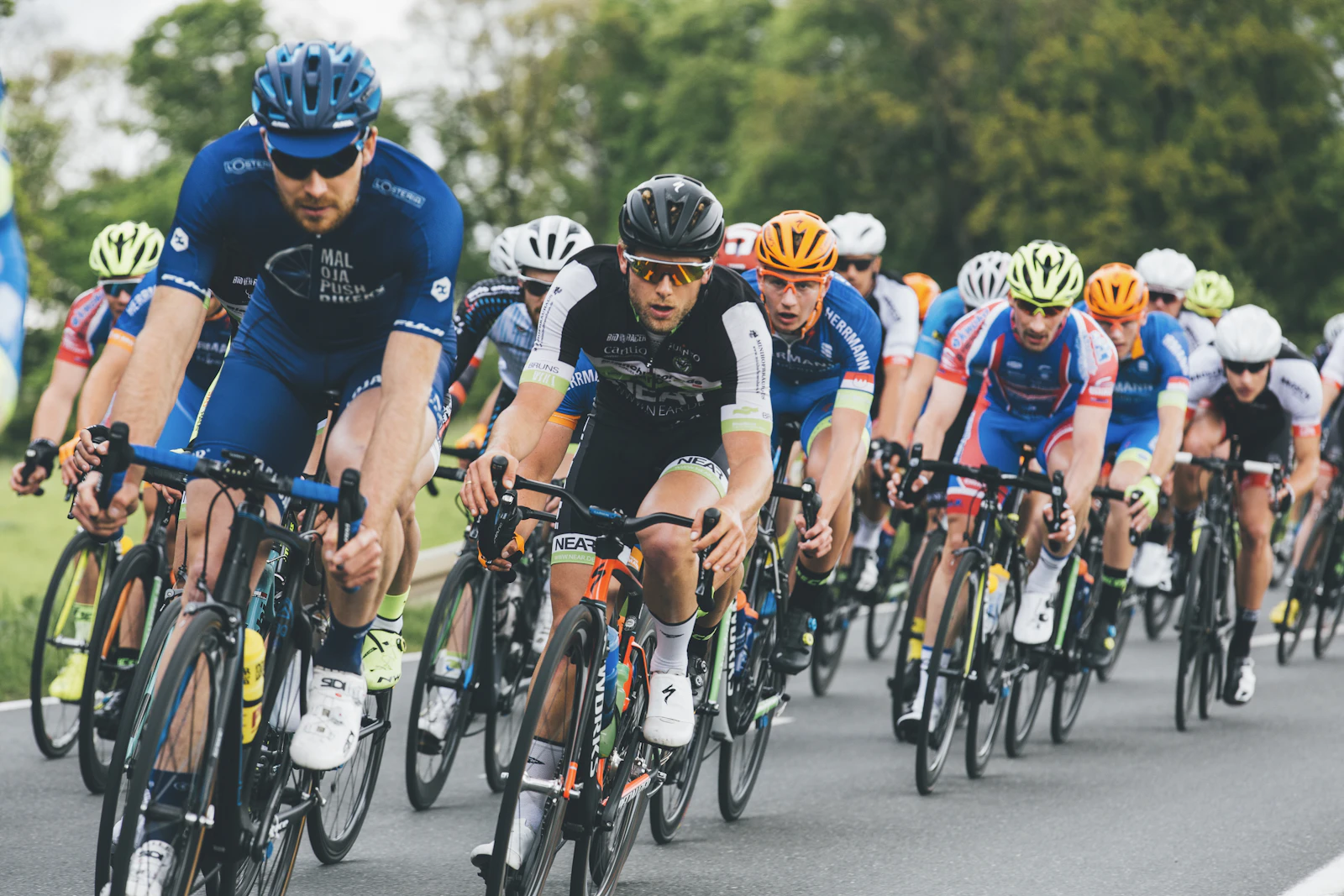
Your first criterium: position, corners and the accordion effect
A crit's average power is often below your FTP, which tells you nothing. What actually decides your first one is where you sit in the bunch — and why the rider at the back is doing a completely different race at the same speed.

Climbing in a bunch: where to sit before the road goes up
The climb rarely loses the race; the two kilometres before it do. Why drafting fades as the road steepens, what the surge at the base costs in W′, and where to be when it starts.

The warm-up, matched to the ride you're about to do
The shorter and harder the effort, the longer the warm-up — and vice versa. Four protocols, from a 10-minute roll-out to a full pre-race routine, plus what to stop doing beforehand.
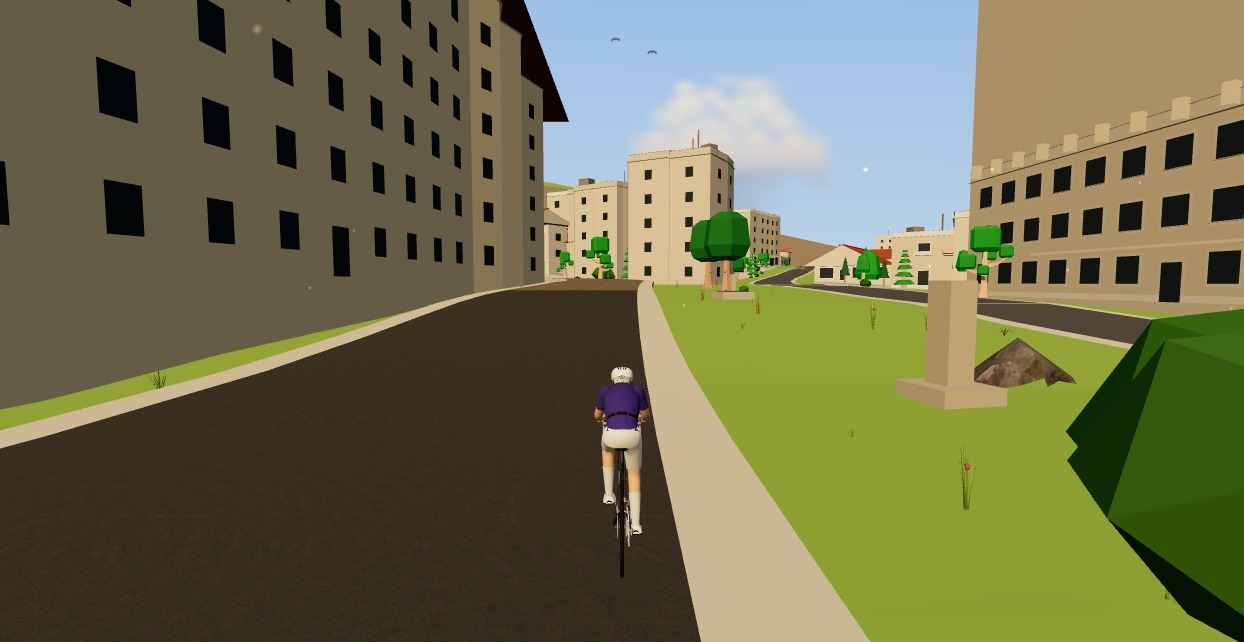
How to preview a race course indoors before you ride it
The best way to know a course is to have ridden it. Here's how to preview a race course indoors — corner by corner, climb by climb — from its GPX file, in 3D, on your smart trainer, weeks before the start line.

Racing abroad: six things that are not like home
The riding is the familiar part. Licences, race manuals, bunch culture, terrain you cannot rehearse, heat and altitude — and the alpine descent that riders underestimate far more often than the climb.
The triathlon bike leg: pacing so you can still run
The bike is the only leg where holding back makes you faster. How to pick a power target for your distance, why draft-legal racing changes everything, and what the run will tell you.

Racing in the cold and wet: staying warm enough to still be racing
Cold rain ends races for riders who were fit enough to finish them, and it usually does it on the descent rather than the climb. Losing your hands before you lose your legs, and the clothing decisions that are really race decisions.

The first 48 hours after a big event: recovery that speeds up the next one
Eat promptly, eat again, drink more than you lost, sleep twice. What the evidence supports in the two days after a gran fondo, and the ice bath, beer and Monday ride that undo it.

How to descend faster and safer: braking, lines and where to look
Descending is the cheapest free speed in cycling and the skill riders practise least. Braking and weight transfer, the line through a corner, where to put your eyes — and why target fixation puts people in ditches.