
The Moveee team
Free coaching · a real route for every ride
The numbers printed on a cassette — 11-28, 11-34, 10-36 — are just tooth counts: the smallest sprocket and the largest. Together with the chainring tooth counts at the front, they tell you everything about how far the bike goes for one turn of the pedals. Once you can read them, you can tell from a spec sheet whether a bike will get you up your local climb at a sensible cadence, and you can stop worrying about how many gears it has. This post is the arithmetic, then what it means on the road.
The only formula you need
Gear ratio is chainring teeth divided by sprocket teeth. A 50-tooth chainring on an 11-tooth sprocket is 50 ÷ 11 ≈ 4.5: the rear wheel turns four and a half times for every turn of the cranks. A 34-tooth ring on a 34-tooth sprocket is 1.0: one turn each. Everything between is the range you have to work with.
To turn that into distance, multiply by the wheel's circumference. A 700c road wheel with a 28 mm tyre rolls roughly 2.1 metres per turn, so:
- 50 × 11 → 4.5 turns × 2.1 m ≈ 9.6 m per pedal stroke. At 90 rpm that is about 52 km/h. You use this going downhill and almost nowhere else.
- 50 × 17 → 2.9 × 2.1 m ≈ 6.2 m per stroke. At 90 rpm, about 33 km/h. A flat road, working.
- 34 × 28 → 1.2 × 2.1 m ≈ 2.6 m per stroke. At 80 rpm, about 12 km/h. A steep climb, sustainable.
- 34 × 34 → 1.0 × 2.1 m ≈ 2.1 m per stroke. At 70 rpm, about 9 km/h. The gear that keeps you seated when the road tilts past ten per cent.
That is the whole trick. Speed = gear ratio × wheel circumference × cadence. Everything else in this post is about choosing the ratio.
Why cadence is the thing you are protecting
Gears exist so that your legs can turn at a cadence that suits them while the road changes. Lucía and colleagues measured professional riders during Grand Tours and found they chose to spin at roughly 90 rpm on flat stages and around 70 on the hardest climbs — high cadences, but lower when the gradient forced it. Foss and Hallén, testing elite cyclists at different workloads, found the most economical cadence rose as power rose: at low power a slow cadence cost least oxygen, at high power a faster one did. Chavarren and Calbet's earlier work showed the same pattern in road cyclists, and Ansley and Cangley's review pulls the strands together — there is no single optimal cadence, but there is a range, it is wider than most beginners think, and the point of gearing is to stay inside it. Kamba and colleagues' 2022 study on gear ratio and cadence found gross efficiency held up across a range of ratios at the same power, which is a useful reassurance: you will not lose much by being one gear off, but grinding at 50 rpm because you have run out of sprockets is a different matter.
For most riders the practical range is roughly 75 to 95 rpm on the flat and 65 to 85 on climbs. If your bike's gearing cannot keep you above about 60 rpm on the steepest hill you ride regularly, the gearing is wrong, not you. Our cadence post goes deeper into the physiology.
Reading a cassette: range versus steps
Two things matter about a cassette and they pull against each other.
- Range. The gap between smallest and largest sprocket. 11-28 gives a 2.5× range; 11-34 gives 3.1×; a 10-36 gives 3.6×. More range means an easier bottom gear for the same top gear.
- Steps. How big the jump is from one sprocket to the next. An 11-speed 11-28 goes 11-12-13-14-15-17-19-21-23-25-28: one-tooth steps where you spend most of your time, then bigger ones. An 11-speed 11-34 has to cover more range with the same number of sprockets, so the steps are larger, and you will notice the cadence jump between gears on a flat road.
This is why "how many gears" is the wrong question. Twenty-two gears with a narrow range is worse for a hilly area than twenty with a wide one; twelve sprockets at the back exist so that manufacturers can offer wide range and small steps at the same time. If the spec sheet says 11-28 and you live somewhere hilly, plan to swap the cassette; it is a cheap, standard job, and our gearing for climbing post has the combinations that work.
Chainrings: compact, semi-compact, and 1×
- Compact (50/34). The default on most road bikes and the right one for almost everyone. Paired with an 11-32 or 11-34 it climbs anything paved.
- Semi-compact (52/36). A slightly taller top gear and a slightly harder bottom one. For fast flat riding and racing.
- Standard (53/39). Racing gearing from an era before wide cassettes. Fine if you race; punishing on a gran fondo.
- Single ring (1×). One chainring, usually 40 to 46 teeth, with a very wide cassette. Simpler, quieter, no front derailleur — and larger steps between gears, which on the road means hunting for the right cadence. Common and sensible on gravel bikes; a compromise on a road bike.
Overlap and cross-chaining
With two chainrings many gears overlap: 50 × 25 and 34 × 17 are both a ratio of 2.0. The overlap is deliberate, because it lets you choose the combination with the straightest chain. Running the big ring with the biggest sprocket, or the small ring with the smallest, bends the chain sideways across the cassette. Spicer and colleagues measured chain-drive efficiency in the laboratory and found it fell measurably as the sprocket got smaller and the chain line worsened, on top of the noise and accelerated wear that anyone can hear. The rule of thumb: big ring for the smaller half of the cassette, small ring for the larger half, and shift at the front before you reach the ends.
Choosing a gear on a climb
A climb is where gearing stops being abstract. Martin and colleagues' validated power model tells you what the road demands: on a gradient the power to lift rider and bike against gravity dominates everything else, and it scales with total mass and speed. At a given power, then, your speed on a climb is more or less fixed, and the gear determines only what cadence that speed produces. Here is the working, in round numbers.
- Know the power you can hold. For a long climb that is something around your endurance-to-tempo range; if you have a power meter, Moveee's Power Profile gives you the numbers and pacing a climb with power explains how to use them.
- Work out the speed. An 80 kg rider-plus-bike holding 200 W on an 8 per cent gradient climbs at roughly 11 km/h once rolling resistance and air are added. This is an estimate from the model, not a measurement of you.
- Pick the ratio that gives a cadence you can hold. 11 km/h at 80 rpm needs about 2.3 metres per pedal stroke, which on a 2.1 m wheel is a ratio near 1.1 — 34 × 32. On a 34 × 28 the same speed forces about 72 rpm; on a 34 × 25 it is 64 rpm and the grind has started, which is why riders who fit the bigger sprocket seldom regret it.
The failure mode is running out of gears and being forced below 60 rpm, where the pedal forces climb sharply and the ride turns into a series of standing efforts. If your climbs feel like that, buy a bigger cassette before you buy anything else. The opposite failure — spinning out on descents — costs you nothing but a few seconds, which is why the smart compromise for a hilly area is always the easier bottom gear.
Indoors, the cassette is your resistance dial
On a smart trainer in ERG mode the trainer sets the resistance and the gear barely matters; on a classic trainer, or riding a route in Moveee Indoor without ERG, the gear does what it does outside. The gears as your resistance dial post covers the indoor case, and big-gear low-cadence work explains the one time deliberately grinding a big gear is a training tool rather than a mistake.
Sources 7
Where this article summarises a study, the study itself is linked — not a write-up of it.
- 1 Lucía A, Hoyos J, Chicharro JL Preferred pedalling cadence in professional cycling · Medicine & Science in Sports & Exercise · 2001
- 2 Foss Ø, Hallén J Cadence and performance in elite cyclists · European Journal of Applied Physiology · 2005
- 3 Chavarren J, Calbet JAL Cycling efficiency and pedalling frequency in road cyclists · European Journal of Applied Physiology and Occupational Physiology · 1999
- 4 Ansley L, Cangley P Determinants of "optimal" cadence during cycling · European Journal of Sport Science · 2009
- 5 Kamba M, Naito H, Ozaki H, Machida S, Katamoto S Effect of Gear Ratio and Cadence on Gross Efficiency and Pedal Force Effectiveness during Cycling · Sports · 2022
- 6 Spicer JB, Richardson CJK, Ehrlich MJ, Bernstein JR, Fukuda M, Terada M Effects of Frictional Loss on Bicycle Chain Drive Efficiency · Journal of Mechanical Design · 2001
- 7 Martin JC, Milliken DL, Cobb JE, McFadden KL, Coggan AR Validation of a Mathematical Model for Road Cycling Power · Journal of Applied Biomechanics · 1998
See this in your own numbers
Moveee builds your power curve, fitness and fatigue from every ride you upload, and writes a training plan around them. It is free, it takes one Strava connection, and it will tell you more about your riding in a week than any article can.
Start freeKeep reading
Indoor cycling app with no power meter: what you get and what you don't
Both columns side by side. What a speed sensor gives you indoors — the route, distance, heart rate, cadence, a ride that counts — and what it cannot: watts, ERG, TSS, FTP. Including why we refuse to show you a virtual power number.

Gearing for climbing: the arithmetic nobody does
The belief that low gears are an admission of weakness has cost riders a great many good days. A table of what your lowest gear actually forces your legs to do at climbing speed — and why a 34×28 on a steep road is a leg press with a view.

The one setting that decides if your speed is right inside the cycling app
A speed sensor counts wheel revolutions, not kilometres. Get the tyre circumference wrong and every number is wrong by the same percentage — up to 10% — while looking entirely plausible. The table, and the two-minute roll-out that beats it.
The best indoor cycling apps in 2026 (an honest round-up)
Zwift, TrainerRoad, Rouvy, MyWhoosh and the rest — what each one is actually for, what it costs, and how to pick the app that matches how you like to ride indoors.

The pain cave setup guide: fans, mats, screens and sweat
Cooling is the single biggest upgrade you can make to indoor training — and it costs less than a cassette. Here's how to build a trainer space you'll actually want to use.

Should you ride when you're ill? A straight answer
The neck check, the symptoms that mean stop, and how to rebuild afterwards without digging a three-week hole. Plus the reassuring truth about how little fitness a week off costs you.

Your first road bike: what to spend and what to ignore
Fit first, then contact points, then a certified helmet. Honest price bands, the spec-sheet numbers that do not matter, and the safety checks that do.

How to calibrate your power meter (and how often)
A zero offset is not a calibration, and temperature moves your numbers more than most riders realise. What each procedure does, how often to do it, and how to tell a drifting meter from genuinely lost fitness.
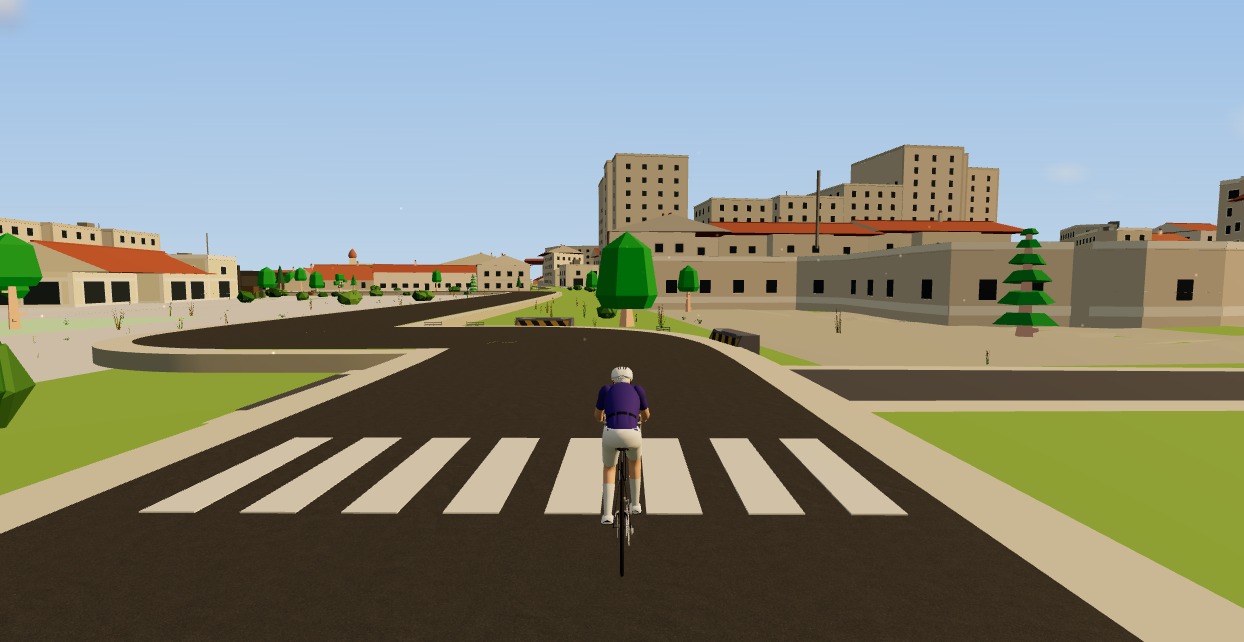
Can you really train indoors in a browser? How Moveee Indoor works in 2026
"In the browser" used to mean toy-grade. Not any more. Here's how a browser now pairs your trainer, holds your watts and renders a real 3D world — and what still needs a native app.

Tyre pressure for cyclists: the numbers that actually make you faster
Harder is faster right up until it isn't — and the point where it stops is lower than the number printed on your sidewall. Rolling resistance, impedance and how to find your own breakpoint.
No ERG mode? How to use your gears as the resistance dial on a dumb trainer
How to run a structured indoor session with no power and no ERG — the way everyone did it until about 2015. Four sessions that work, how to steer by heart rate despite its lag and drift, and the one caveat about your training plan.

Climbing technique: seated vs standing, and how to pace long climbs
Standing costs more oxygen at the same power — and is still the right choice sometimes. Gearing and cadence on a long climb, when to get out of the saddle, and how to pace twenty minutes uphill without blowing.