
The Moveee team
Free coaching · a real route for every ride
Ask a hundred cyclists what would most improve their indoor training and most will say a better trainer, a faster app, or more discipline. Almost none will say "a bigger fan." They're wrong. Cooling is the single highest-return upgrade in indoor cycling, and it costs less than a chain and cassette.
Here's how to build a trainer space you'll actually want to use, ranked by what genuinely matters.
Outdoors, moving at 30 km/h, you have a constant 30 km/h wind stripping heat off your skin. Indoors you have none of that while producing the same heat. Your core temperature climbs, your heart rate drifts up, your power falls, and the session ends early — and it feels like a fitness problem when it's a ventilation problem. Buy the fan first.
The priority list
Work down this list in order. Each item costs less than the trainer and several will change your sessions more than the trainer did.
A proper fan (or two)
Huge €40–120Heat is the number one limiter of indoor performance — not your legs, not your fitness. A high-volume fan aimed at your chest and face will do more for your session quality than any component you can bolt to the bike.
Trainer mat
High €30–70Catches sweat, protects the floor, and dampens the vibration that travels through a building and annoys everyone in it.
Somewhere to put a screen
High €20–150A wobbling laptop on a stool ruins sessions. A stable stand or wall mount at eye level makes the whole thing feel deliberate.
Sweat guard + towels
Medium €15–40Sweat is genuinely corrosive. It gets into headsets, stems and bolts, and it will quietly destroy a frame over a couple of winters.
Heart rate strap
Medium €40–90Adds the physiological half of the picture to your power data — particularly useful for spotting when heat is cooking you.
Dedicated trainer tyre or wheel
Nice to have €30–80Wheel-on trainers only. Saves shredding good rubber and stops the swap being a chore. Direct-drive users can skip this.
Better lighting
Nice to have €20–60A dim garage is a depressing place to spend an hour. Cheap, and it changes how the space feels more than you'd expect.
Getting the fan right
Since it's the top of the list, it's worth being specific:
- Aim for the chest and face, not the legs. That's where you dump the most heat and where the cooling feels most effective.
- Volume beats speed settings. A large, high-airflow fan on medium beats a small desk fan screaming on maximum.
- Two is meaningfully better than one. One low aimed at the torso, one higher at the head. This is the cheap upgrade almost nobody makes.
- Get it close. Airflow falls off fast with distance — a metre away is dramatically better than three.
- Open a window if you can. Recirculating hot air in a sealed garage has limits; fresh air genuinely helps.
Three builds
The bare minimum
One good fan
A cheap mat or old rug
Phone or laptop propped safely
Genuinely enough. Don't let kit be the reason you don't start.
The sensible setup
Two fans — chest and face
Proper trainer mat
Stable screen at eye level
Sweat guard + HR strap
Where most riders should land. Comfortable enough that you'll use it all winter.
The full cave
Big industrial fan
Large TV or monitor
Rubber gym flooring
Dedicated bike left set up
Speakers, good lighting, heater for winter
Diminishing returns beyond the sensible setup — but it's a lovely place to train.
The details that catch people out
- Noise travels through structure, not just air. If you're in a flat or above a bedroom, a thick mat and a direct-drive trainer matter more than any decibel figure on the box.
- Heat in summer is worse than cold in winter. A garage that's pleasant in January is unusable in July. Plan ventilation for both.
- Leave the bike set up if you possibly can. The five-minute swap sounds trivial and is the single most common reason a session doesn't happen.
- Keep a bottle within reach — and use it. Indoor sweat rates are far higher than most riders assume. Two bottles an hour is not unusual.
- Wipe the bike down afterwards. Thirty seconds with a cloth saves a corroded stem bolt in April.
The last piece: what's on the screen
You've cooled the room, stabilised the screen and protected the floor. The remaining variable is what you actually look at for the next hour — and that's the difference between an hour that drags and one that disappears.
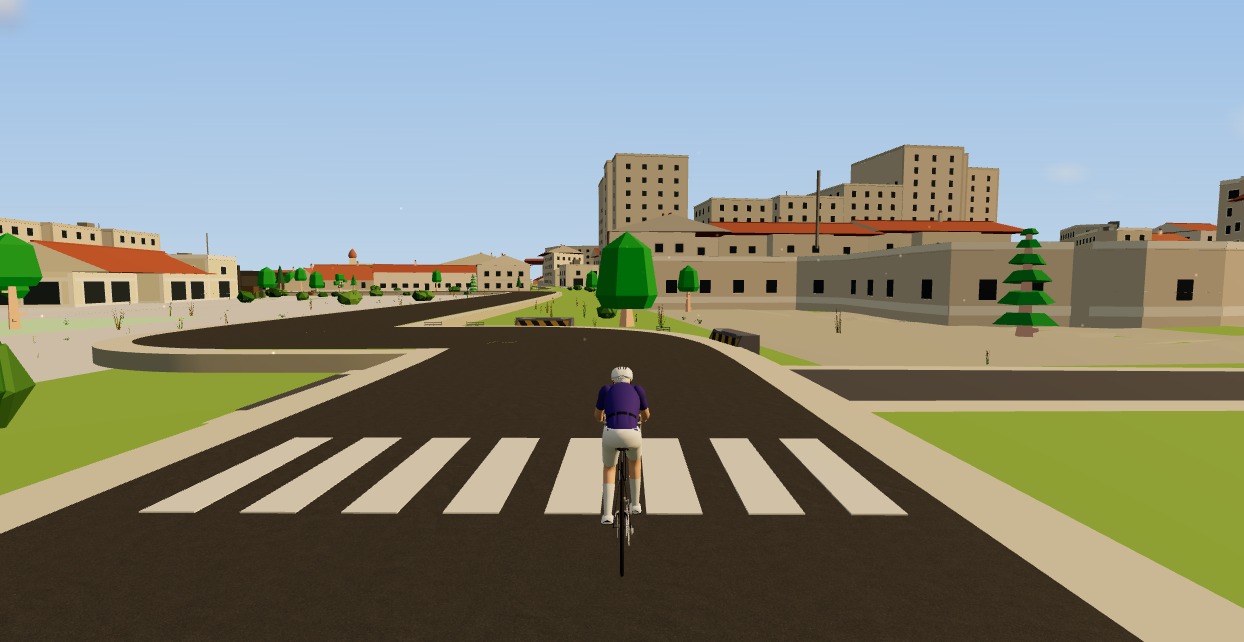
That's the gap Moveee Indoor was built for. Instead of a fictional world, it renders your own saved routes in 3D from real map and elevation data — the actual streets, buildings and climbs of the roads your route follows. Ride your summer loop in January, or recon a course you've entered before you get there. It runs in the browser, so there's nothing to install on the laptop you just mounted to the wall, it holds your interval targets in ERG mode, and it's free while it's in alpha.
Build the space, point the fan at your chest, and give yourself somewhere worth looking. The best pain cave isn't the most expensive one — it's the one you keep walking into.
Sources 6
Where this article summarises a study, the study itself is linked — not a write-up of it.
- 1 Périard JD, Eijsvogels TMH, Daanen HAM Exercise under heat stress: thermoregulation, hydration, performance implications, and mitigation strategies · Physiological Reviews · 2021
- 2 Saunders AG, Dugas JP, Tucker R, Lambert MI, Noakes TD The effects of different air velocities on heat storage and body temperature in humans cycling in a hot, humid environment · Acta Physiologica Scandinavica · 2005
- 3 Coyle EF, González-Alonso J Cardiovascular Drift During Prolonged Exercise: New Perspectives · Exercise and Sport Sciences Reviews · 2001
- 4 Mieras ME, Heesch MWS, Slivka DR Physiological and Psychological Responses to Outdoor vs. Laboratory Cycling · Journal of Strength and Conditioning Research · 2014
- 5 Baker LB Sweating Rate and Sweat Sodium Concentration in Athletes: A Review of Methodology and Intra/Interindividual Variability · Sports Medicine · 2017
- 6 Sawka MN, Burke LM, Eichner ER, Maughan RJ, Montain SJ, Stachenfeld NS American College of Sports Medicine position stand: Exercise and Fluid Replacement · Medicine & Science in Sports & Exercise · 2007
Your own roads, indoors, in a browser tab
Moveee Indoor pairs your smart trainer over Bluetooth and rebuilds a route you have saved as a 3D road — real gradients, ERG for the intervals, and the ride saved with full power data. Nothing to install. Free while it is in alpha.
Start an indoor rideKeep reading
A free MyWhoosh alternative that rides your own real routes
MyWhoosh proved indoor cycling can be free. If you want a free MyWhoosh alternative that rides your own real roads instead of a fictional world — and runs in the browser with nothing to install — here's the honest comparison.

Gears explained: what the numbers on your cassette mean
Tooth counts to gear ratios to speed at a cadence, why steps matter more than the number of gears, what cross-chaining costs, and how to pick a gear on a climb.

A free indoor ride in your browser: how far Moveee Indoor gets you for nothing
How much real indoor training can you get without paying a subscription or installing anything? Quite a lot, as it turns out. Here's the free browser setup, end to end.
The best indoor cycling apps in 2026 (an honest round-up)
Zwift, TrainerRoad, Rouvy, MyWhoosh and the rest — what each one is actually for, what it costs, and how to pick the app that matches how you like to ride indoors.

Browser-based indoor cycling: the apps you can ride with zero downloads
Most indoor cycling apps still want you to install a small game. A handful don't. Here's the honest state of browser-based indoor training in 2026 — what runs in a tab, and how well.
Speed sensor or smart trainer: when is the upgrade actually worth it?
Four signs you have outgrown a speed-only setup, what power actually unlocks, and three routes compared — including the one most people overlook, which is a power meter rather than a trainer. Plus the honest case for staying where you are.
The best free Zwift alternative in 2026
Zwift is no longer the only game in town, and some of the best options cost nothing. Here's an honest guide to the best free Zwift alternative in 2026 — what each one does well, and how to pick the one that fits how you ride.

No app store, no install: online cycling training with Moveee Indoor
You don't need an app store, an admin password or 12 GB free to train indoors. Here's what "online, no-install" cycling training actually looks like in practice — and who it suits.

A free FulGaz and Kinomap alternative for real-road rides
FulGaz and Kinomap ride real roads on video. If you want a free FulGaz and Kinomap alternative that rebuilds real roads in 3D — including routes you've drawn yourself — and runs in the browser, here's how it stacks up.

Indoor cycling on any device: how Moveee Indoor runs in the browser (even on a Mac)
Mac, Windows, Linux, a Chromebook or an Android tablet — if it runs Chrome or Edge, it can run a full trainer session. Here's how one browser app rides on all of them, and the one gap (iOS).

Tyre pressure for cyclists: the numbers that actually make you faster
Harder is faster right up until it isn't — and the point where it stops is lower than the number printed on your sidewall. Rolling resistance, impedance and how to find your own breakpoint.

Everesting indoors: how to climb 8,848 m without leaving your pain cave
One climb, repeated until you've ascended the height of Everest — indoors, where there's no weather, no traffic, and absolutely nowhere to hide. The gradient maths, the pacing (it's an eating contest with pedalling attached), the two-fan setup, and the fitness you honestly need before you try.