Winter training for cyclists: how to come out of winter faster than you went in
The Moveee team
Free coaching · a real route for every ride
There's an old line that the season is won in winter. It's true, but not in the way most riders take it. Winter isn't won by grinding yourself into the ground in December — it's won by arriving in March healthy, motivated and aerobically fitter than you were in October. Plenty of riders get the first part right and blow the second, turning up to spring already tired of their bike.
Here's a realistic, indoor-first winter that works around dark evenings, bad roads and a normal life.
Take two to three genuinely easy weeks after your last event. Then build aerobic volume from December, mostly indoors and mostly easy, with one hard session a week to keep your top end alive. Add real intensity from February as the days lengthen. Protect one long ride, lift weights twice a week, and take an easy week every fourth week before you're desperate for it.
Month by month
Hours are a sensible range for an amateur with a job — scale the whole thing up or down to fit your life, keeping the shape intact.
November
Transition · 4–6 hr/wk
Come down from the season. Ride when you feel like it, lift some weights, fix the bike.
Deliberately unstructured. Two to three weeks of this prevents the burnout that ends February.
December
Base 1 · 5–8 hr/wk
Rebuild the aerobic engine. Mostly Z2, one tempo or sweet-spot session a week.
Consistency beats intensity. Turning up four times a week matters more than any single ride.
January
Base 2 · 6–9 hr/wk
More of the same, slightly longer. Add a second sweet-spot session; start extending the weekend ride.
The hardest month mentally. Structure and something to look at are what get you through it.
February
Build 1 · 6–9 hr/wk
Introduce real intensity: threshold intervals and the first VO2 max work.
Cut volume slightly as intensity rises. You cannot add both at once and recover.
March
Build 2 · 7–10 hr/wk
Sharpen. Race-specific efforts, over-unders, and the first proper outdoor long rides.
Start moving sessions outdoors as light returns — specificity begins to matter again.
Six principles that matter more than the plan
Protect consistency above all
Four honest hours every week for four months beats a heroic ten-hour week followed by three weeks off ill. Winter fitness is built by turning up.
Don't skip intensity entirely
The old 'all base, no intensity until spring' advice leaves you flat. One hard session a week from December keeps your top end from disappearing.
Lift something heavy
Two short gym sessions a week through winter improve durability, bone density and injury resistance — and they're easier to face than another turbo hour.
Keep one long ride
Even at 2–3 hours, one longer ride a week preserves the endurance you'll need in spring. Outside if the roads are safe; indoors with a film if they aren't.
Plan a mid-winter break
A deliberate easy week in early January — before you need it — is far more effective than an enforced one in February when you're fried.
Fix the fuelling
Winter is when riders under-eat and get ill. Cold weather and indoor sweat both raise demand. See our carbs-per-hour guide.

Outside or in?
You don't have to pick a side. A good winter uses both, on purpose:
- Go outside when the roads are dry and safe, for your long endurance ride. Daylight, real terrain and fresh air do things for your head that no screen can.
- Stay in for anything hard. Intervals need precision, and precision is impossible when you're braking for ice, stopping at junctions or fighting a crosswind.
- Stay in when it's dark, icy or genuinely dangerous. A crash in January costs you the whole season. No session is worth that.
We wrote a longer, honest head-to-head on this in indoor vs outdoor training.
Surviving January
Let's be honest about the real enemy. It isn't fitness or physiology — it's the fourth Tuesday in a row on the trainer in a cold garage when it's dark at five. That's what ends winters.
Three things reliably help. Structure: a session with a visible end ("three of four intervals done") is far easier than an open-ended slog. Company: a group ride or a friend on the other end of a call changes the hour entirely. And somewhere to look that isn't a wall.
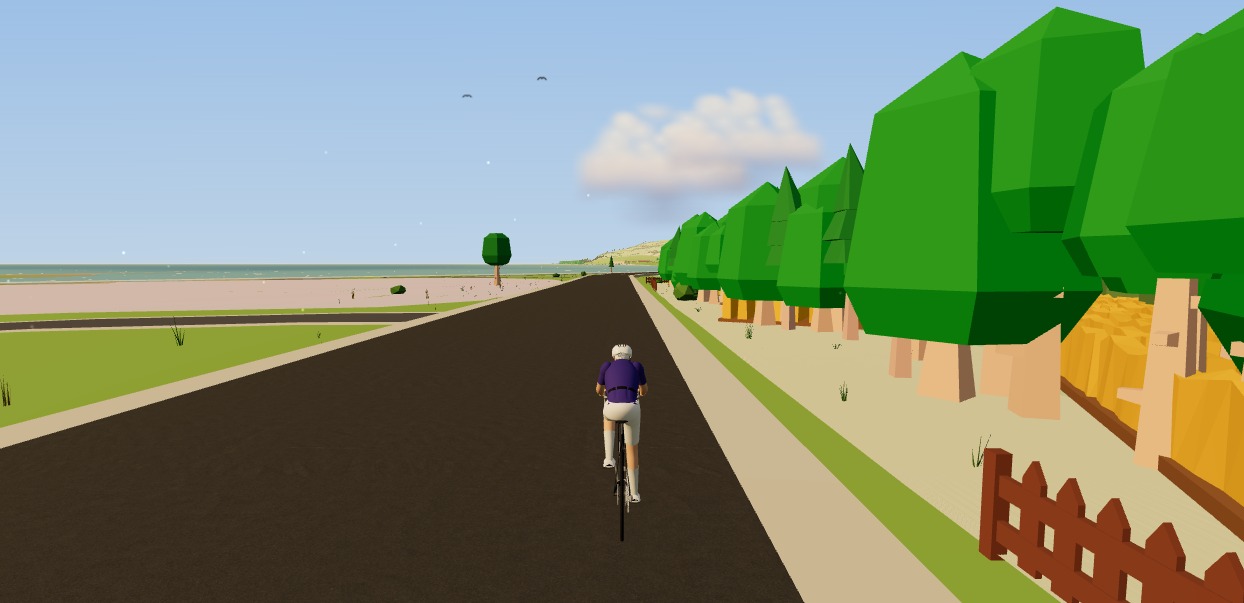
That last one is why we built Moveee Indoor the way we did. Rather than a fictional world, it renders your own routes from real map and elevation data — so on a wet January evening you can ride your favourite summer loop, or reconnoitre the course of the gran fondo you've entered for June, turn by turn on the actual roads. It runs in the browser with nothing to install, holds your interval targets in ERG mode, and it's free while it's in alpha. Riding somewhere you have a reason to care about makes the winter hours pass very differently.
The measure of a good winter
Not your February FTP. The right test is simpler: are you fitter than in October, still healthy, and looking forward to spring? Riders who nail all three start the season on the front foot. Riders who chase winter numbers often peak in March and are cooked by June.
If you'd rather not plan all this yourself, Moveee writes the whole block for you — periodised around the days you can actually ride, adapting when you miss one, with a real route for every outdoor session and a structured workout for every indoor one. It's free, and it learns your engine from the rides you've already done.
Sources 7
Where this article summarises a study, the study itself is linked — not a write-up of it.
- 1 Seiler S What is best practice for training intensity and duration distribution in endurance athletes? · International Journal of Sports Physiology and Performance · 2010
- 2 Stöggl T, Sperlich B Polarized training has greater impact on key endurance variables than threshold, high intensity, or high volume training · Frontiers in Physiology · 2014
- 3 Rønnestad BR, Mujika I Optimizing strength training for running and cycling endurance performance: a review · Scandinavian Journal of Medicine & Science in Sports · 2014
- 4 Olmedillas H, González-Agüero A, Moreno LA, Casajus JA, Vicente-Rodríguez G Cycling and bone health: a systematic review · BMC Medicine · 2012
- 5 Walsh NP Recommendations to maintain immune health in athletes · European Journal of Sport Science · 2018
- 6 Meeusen R, Duclos M, Foster C, et al. Prevention, diagnosis, and treatment of the overtraining syndrome: joint consensus statement of the European College of Sport Science and the American College of Sports Medicine · Medicine & Science in Sports & Exercise · 2013
- 7 Issurin VB New horizons for the methodology and physiology of training periodization · Sports Medicine · 2010
See this in your own numbers
Moveee builds your power curve, fitness and fatigue from every ride you upload, and writes a training plan around them. It is free, it takes one Strava connection, and it will tell you more about your riding in a week than any article can.
Start freeKeep reading

The cycling year: how to plan twelve months from off-season to peak
Transition, base, build, peak, race: what each block is for, how long it runs for an amateur with one summer goal, and where the neat diagram and the messy year part ways.

Strength training for cyclists: sets, reps and when in the season
Heavy or explosive, how many sets, and where it goes in a week that already contains intervals. The programming detail behind the evidence that lifting makes cyclists faster — including the interference effect.
Overtraining vs overreaching: how to tell the difference before it costs you months
Planned overreaching makes you faster. True overtraining syndrome can take a season. The difference is mostly time — here's what separates them, what markers are worth watching, and the honest limits of self-diagnosis.

Your FTP went down. Six reasons, and only one of them is fitness
Same trainer, same test, twelve watts lower. Before you rewrite the plan: a lower test result usually is not lost fitness. The six causes in order of how often they turn out to be the answer, and the five-minute check that tells you which.

8 indoor cycling workouts that actually make you faster
Sweet spot, over-unders, VO2 max, sprints and more — eight proven trainer sessions written out rep by rep, with what each one builds and when to use it.

How long does it take to get cycling fit? A realistic timeline
Two weeks until rides stop feeling awful, six to eight until the numbers move, a season until club runs feel comfortable, years until the engine matures. An honest milestone-by-milestone timeline of cycling fitness — what genuinely speeds it up, what doesn't, and why coming back is faster than starting.

Cross-training for cyclists: running, skiing and swimming that transfer
Fitness built in another sport reaches the bike through your heart and lungs, not your legs. What the transfer studies say, and how skiing, running and swimming rank.

How to build a cycling training plan around a full-time job
You don't need 12-hour weeks to get properly fast — you need the right 6–8 hours, placed where your life can actually hold them. Here's how to anchor a working week around two quality sessions and one long ride, what to cut first when work explodes, and why a plan that adapts beats a plan that's perfect.

Over-unders: the interval that teaches you to ride through lactate
The session that turns "I blew on the third climb" into "I was there at the top" — and one of the most frequently botched workouts in cycling. Four versions in order of difficulty, and the four ways riders ruin them.

Indoor training with heart rate only (no power meter, no problem)
No power meter, no smart trainer — just a heart-rate strap? You can still train properly. How to find your threshold heart rate with one honest 30-minute test, set five zones from it, structure a week around what HR measures well, and work around what it doesn't (lag, drift and hot rooms).
Does your speed in an indoor cycling app actually mean anything?
It is an honest measurement of exactly one thing: how fast your back wheel is spinning. What that is genuinely useful for, why it is not your road speed, and why the hill on screen does not slow you down when you ride on speed alone.

The first 48 hours after a big event: recovery that speeds up the next one
Eat promptly, eat again, drink more than you lost, sleep twice. What the evidence supports in the two days after a gran fondo, and the ice bath, beer and Monday ride that undo it.