
The Moveee team
Free coaching · a real route for every ride
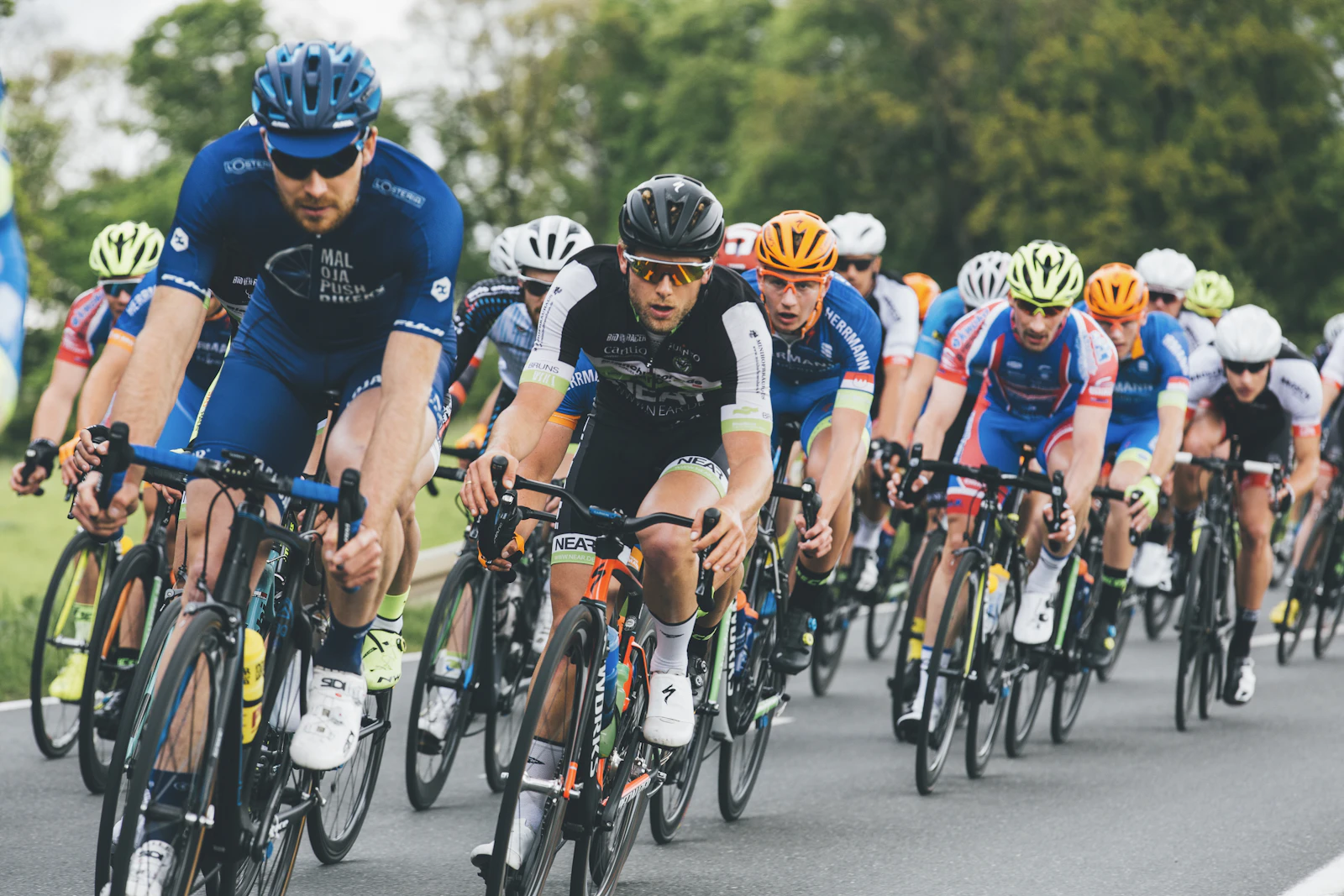
A breakaway is four riders off the front of eighty, and on the face of it that should never work. The bunch has more riders, more shelter and more collective horsepower. And yet moves go clear, and some of them stay clear, and the reason is a piece of arithmetic that is worth understanding properly if you intend to race.
Most amateur riders learn breakaways by accident: they find themselves in one, ride too hard, get caught, and conclude that breaks do not work. The truth is narrower. Breaks work under specific conditions, and being able to recognise those conditions from inside the bunch is most of the skill.
Drafting is why any of this happens
Above about 30 km/h, the overwhelming majority of the power you produce goes into pushing air out of the way. Sitting behind another rider means somebody else has already done part of that job for you, and the saving is large.
The foundational measurements go back to wind-tunnel work in the 1970s, which found that closely following another rider cut wind resistance substantially. Field measurements of oxygen cost agreed: drafting a single rider at typical racing speeds reduced the oxygen cost of riding by roughly a fifth to a quarter, with the saving growing as speed increased. And modern computational fluid dynamics of a full peloton found something far more dramatic still — riders sheltered in the middle and rear of a large bunch experienced drag as low as 5–10% of an isolated rider's.
Stylised. Real values swing widely with speed, spacing, formation and crosswind — the peloton figure in particular comes from simulation of one specific bunch shape. Treat the ordering as solid and the exact percentages as indicative.
On the front
100% of solo drag
No shelter at all. This is the reference everything else is measured against.
Second wheel
70% of solo drag
Close following of a single rider. Wind-tunnel and field work put the saving somewhere around 25–35% at racing speeds.
Fourth in a small group
58% of solo drag
Riders further back gain a little more, because the group as a whole has already disturbed the air.
Mid-pack in a big bunch
10% of solo drag
CFD simulation of a full peloton found drag in the sheltered middle-rear falling to roughly 5–10% of an isolated rider. This is the number that explains everything about road racing.
So why does a break ever stay away?
Read that table again and the puzzle gets worse. A rider in a break is rotating through the wind every thirty seconds, paying something like 70–100% of solo drag much of the time. A rider in the bunch might be paying 10%. On raw energetics, a break of four against a committed peloton should be caught, always.
Three things stop that happening.
The bunch usually is not committed. A peloton chases at the pace of whichever teams have a reason to chase, and only for as long as they think the effort is worth it. A break survives on the days when nobody left behind wants to spend a team's whole race pulling it back for someone else's sprinter. This is not physiology. It is arithmetic about incentives, and it is why the composition of the move matters more than its strength.
The bunch cannot use its advantage at low speed. The shelter figures above are about air. On a long climb at 18 km/h, or on a narrow twisting lane, or in a crosswind that strings the field into a line, the peloton's aerodynamic edge shrinks dramatically and its size stops helping. Almost every break that survives does so over terrain that suppresses the bunch's advantage.
The maths of closing a gap is unforgiving in both directions. Modelling of breaking away and chasing showed what riders know intuitively: the speed difference between a committed chase and a committed break is usually small, so gaps close slowly, and the distance remaining matters enormously. A minute of advantage with 10 km left is a very different thing from a minute with 60 km left. The usual club rule of thumb — that a chasing bunch takes back roughly a minute for every 10 km — is a rule of thumb rather than a research finding, but it is the right order of magnitude and it is a useful way to decide whether to commit.

Reading which move to go with
Most riders in their first season go with the wrong moves — the ones that feel dramatic, early, and contain nobody dangerous. Four things actually predict whether a move has a chance.
A move with one rider from each of the four strongest teams is a move the bunch may not chase, because nobody left behind has a reason to work. A move with three riders from the same team is a move that gets shut down inside a kilometre.
A break going away onto a narrow, twisting, exposed or climbing section has a real chance, because that terrain reduces the bunch's aerodynamic advantage. A break going away onto a wide, flat main road usually does not.
Early moves rarely survive but cost little to try. Moves inside the last 20 km are expensive and decisive. Know which one you are in before you commit.
The move that feels right is usually the one where you happened to be well positioned. Look at who went. If the riders around you are strong, willing and not marked, that is the signal — not your legs.
To be in the right move you also have to be in the right part of the bunch, which is the unglamorous half of this skill. Moves go from the front third, and if you are sitting in the last twenty riders you will watch the decisive one leave. That is the same positioning problem we describe in your first road race and, in its most concentrated form, in criterium racing.
Through-and-off, properly
A break is only as fast as its worst rotation. Get this right and four moderate riders will hold off a chase that should have caught them; get it wrong and you will produce a series of small accelerations that shred your own group.
Pull off into the wind
If the wind is from the left, the rider finishing a turn pulls off to the left. That puts the recovering line on the sheltered side. Getting this backwards is the most common error in amateur through-and-off, and it costs the group real speed.
Keep the effort even, not the speed
Do not accelerate when you hit the front. Hold the same power and let the rotation do the work. A group that surges each time the lead changes is a group that will be caught.
Short turns, honestly done
Fifteen to thirty seconds on the front is plenty. If you cannot do that any more, say so and sit on the back — an honest passenger is more useful than a rider who takes a turn and then blows.
Close the gap smoothly
Slide back along the line and rejoin at the rear without a gap opening. Every gap has to be closed by somebody, and closing gaps is what empties a break.
Team pursuit research is the cleanest illustration of why smoothness pays: measured drag reductions for riders behind the leader run to roughly a third or more, but only while the formation holds its spacing. A rider who drifts a bike length back in the rotation gives up a meaningful share of that saving and then has to spend energy closing the gap. The same skills that make a club run pleasant make a break fast, and we cover the basics in riding in a group.
When to commit, and when to sit up
Committing to a break is a bet that costs you the rest of your race if it fails. Three questions are worth asking before you go.
- Can you hold this pace for the time remaining? A break that has 40 km to ride is, for you, a 40-minute-plus time trial with company. If the pace in the first five minutes is above what you can sustain for an hour, you are not in a breakaway; you are in a countdown. The pacing logic is the same as in pacing a time trial with power.
- Is everyone working? One passenger in a group of four is survivable. Two is not. If riders are sitting on because their teammates are behind, the move is already dead and you are doing somebody else's work.
- What does being caught cost you? If you are riding for a result and the answer is "everything", be selective. If you are riding for experience, go with everything and find out what happens — that is genuinely how you learn which moves are which.
Sitting up is a legitimate decision, not a failure. Sit up early, get back in the bunch while it is still moving steadily, and eat something. Sitting up 200 m before the catch, having emptied yourself, is the worst of both outcomes.
The physiological side of that decision is worth knowing about yourself before race day. The initial acceleration to establish a gap is a hard, short effort that spends a chunk of your capacity above threshold, and how much you have and how fast it refills determines whether you can settle into the break afterwards or spend ten minutes hanging on. Your power profile shows both halves — the 30-second and 1-minute numbers that get you across the gap, and the 20-to-60-minute numbers that keep you there. A rider strong in the first and weak in the second should join breaks late rather than early, and there is no shame in that; it is simply the shape of the curve.
The uncomfortable summary
Breakaways are not primarily a test of strength. They are a test of whether you read the race correctly, whether the terrain is on your side, and whether the bunch behind you has any reason to care. The strongest rider in an amateur field spends most of the season being caught at 2 km to go because they keep going with the wrong moves at the wrong time.
Spend a few races watching instead of attacking. Note which moves go clear and what they had in common — how many riders, from how many teams, on what sort of road, with how far to go. After three or four races the pattern becomes obvious, and the next time it appears you will already be near the front.
Sources 9
Where this article summarises a study, the study itself is linked — not a write-up of it.
- 1 Kyle CR Reduction of Wind Resistance and Power Output of Racing Cyclists and Runners Travelling in Groups · Ergonomics · 1979
- 2 McCole SD, Claney K, Conte JC, Anderson R, Hagberg JM Energy expenditure during bicycling · Journal of Applied Physiology · 1990
- 3 Blocken B, van Druenen T, Toparlar Y, Malizia F, Mannion P, Andrianne T, Marchal T, Maas GJ, Diepens J Aerodynamic drag in cycling pelotons: New insights by CFD simulation and wind tunnel testing · Journal of Wind Engineering and Industrial Aerodynamics · 2018
- 4 Blocken B, Toparlar Y, van Druenen T, Andrianne T Aerodynamic drag in cycling team time trials · Journal of Wind Engineering and Industrial Aerodynamics · 2018
- 5 Barry N, Burton D, Sheridan J, Thompson M, Brown NAT Aerodynamic drag interactions between cyclists in a team pursuit · Sports Engineering · 2015
- 6 Olds T The mathematics of breaking away and chasing in cycling · European Journal of Applied Physiology · 1998
- 7 Martin JC, Milliken DL, Cobb JE, McFadden KL, Coggan AR Validation of a Mathematical Model for Road Cycling Power · Journal of Applied Biomechanics · 1998
- 8 Sanders D, van Erp T The Physical Demands and Power Profile of Professional Men's Cycling Races: An Updated Review · International Journal of Sports Physiology and Performance · 2021
- 9 Jones AM, Vanhatalo A The 'Critical Power' Concept: Applications to Sports Performance with a Focus on Intermittent High-Intensity Exercise · Sports Medicine · 2017
Plan backwards from your event
Give Moveee your event date and it works back from it — the long rides where they belong, the sharpening in the right week, and a taper that arrives on time. It adapts when you miss a session, because you will.
Plan my eventKeep reading

Your first road race: what actually happens, and how to not get dropped
A road race is not a hard group ride — it's several hundred surges with recoveries you don't control. What the power profile of a bunch race looks like, why the first ten minutes hurt most, and how to prepare for it.

Race day nutrition plan: hour by hour
Breakfast, the hour before, the start, and every hour after that. A concrete fuelling timeline for a two-hour race and a six-hour one, with the carbohydrate and fluid numbers the research supports.

Pre-race openers: the day-before session that wakes your legs up
Complete rest the day before an event often leaves you feeling flat. What an opener session does, what it should look like, and how long before the start it's worth doing.

Racing on consecutive days: how to recover between stages
The refuelling rules you can safely ignore in a normal training week become the whole game when you race again in eighteen hours. Glycogen arithmetic, what sleep is worth, and which recovery gadgets survive contact with the evidence.

Climbing in a bunch: where to sit before the road goes up
The climb rarely loses the race; the two kilometres before it do. Why drafting fades as the road steepens, what the surge at the base costs in W′, and where to be when it starts.

How to train for your first gran fondo (a 12-week plan you can actually follow)
A gran fondo is a long day in the saddle — but it's very doable with the right build. Here's a realistic 12-week plan, the key workouts, and how to pace and fuel the big day.

How to build a sprint that actually wins things
Almost every race finishes in a scramble, and the sprint is the least-trained quality in amateur cycling. The four phases, five sessions, and the recovery mistake that ruins most of them.
Your first century: 100 miles, and how to arrive with legs left
Build the long ride to about 120 km, ride the first two hours slower than feels necessary, eat from the first hour and sit in the group. A race-prep guide to 161 km that finishes well rather than merely finishes.

Pre-race nerves: a routine that works in the last hour
You cannot switch the nerves off, but you can point them somewhere. A last-hour routine built on reappraisal, slow breathing, a proper warm-up and two sentences of self-talk.

How to pace a time trial with power
The first two minutes decide most time trials, and usually badly. How to pick a target, why even pacing wins on flat courses but not hilly ones, and how to spend your energy above threshold deliberately.
Your first criterium: position, corners and the accordion effect
A crit's average power is often below your FTP, which tells you nothing. What actually decides your first one is where you sit in the bunch — and why the rider at the back is doing a completely different race at the same speed.

ERG mode in the browser: hold your watts on any smart trainer
ERG mode used to mean installing a desktop app. Not any more. Here's how ERG mode in the browser works — how a tab sets the resistance on your smart trainer and holds your target watts through every interval, free.