The Moveee team
Free coaching · a real route for every ride
Your first road race will not feel like any ride you have done before, and the specific way it will surprise you is this: the average power will be unremarkable and you will be closer to blowing up than you have ever been.
Mass-start racing is not an endurance test with a sprint at the end. It is a long sequence of hard efforts separated by uneven, unpredictable recovery — dictated by other people, never by you. Understanding that changes both how you prepare for it and how you ride it.
What a race actually looks like as a power file
Compare a steady solo ride with the same duration of bunch racing. Both traces below are stylised, but the shapes come straight from what race files look like.
Steady. You choose the effort, and it barely changes.
Spiky. Repeated efforts far above threshold, separated by near-freewheeling in the bunch — and a final spike bigger than all of them.
The catch: both of those files can produce a similar average power. Average is close to meaningless in a race — the demand is in the distribution, not the mean.
Studies of race data in professional cycling describe exactly this pattern: a stochastic, highly variable power output with large numbers of short efforts at very high intensity, and long stretches spent at low power sheltered in the bunch. Analyses of women's and men's professional racing find the same structure — hundreds of brief supra-threshold efforts across a race, concentrated around the decisive moments.
And the finish is more extreme than most people expect. Work on sprint demands in professional road racing found that the last minutes before a bunch sprint are ridden at a very high intensity before the sprint itself even starts. The sprint is the top of a ramp, not a standing start.
Why the first ten minutes hurt most
New racers almost universally report the same thing: they nearly got dropped in the opening kilometres, then felt fine later. There are three reasons, and none of them are about fitness.
- Everyone is fresh and nobody has settled. Attacks go repeatedly until a move sticks. Until then, the pace is set by whoever is currently attacking.
- The bunch is fighting for position before the first narrowing, corner or climb, which means constant accelerations independent of the actual race situation.
- Your body is not ready. Oxygen uptake takes minutes to rise, so the earliest hard efforts draw disproportionately on your finite anaerobic reserve. Starting cold means paying for the first surges with the reserve you needed for the fourth.
The last one is the only one you control, and it has a simple fix: warm up properly. Fifteen to twenty minutes with a few short efforts at race intensity, finishing close to the start. It is the highest-return ten minutes in your whole day.
Everyone is fresh, attacks go constantly, and the bunch is fighting for position before the road narrows. Expect repeated efforts well above threshold with almost no recovery. It is genuinely harder than the finish for most first-timers.
A break goes or the pace calms. This is where you eat, drink and move up. It is also where inattention drops riders out of the back on a single climb.
Splits happen on hills, in crosswinds and after crashes. Being ten places further forward is worth more than being fifty watts stronger here.
Pace lifts, positioning gets desperate, and the last few kilometres are a sequence of sprints. Whatever you saved is spent here, whether you meant to or not.

Positioning is most of the race
Sitting in the bunch rather than in the wind is worth an enormous amount. Wind-tunnel and computational work on pelotons has found that riders deep in a large bunch can experience only a small fraction of the drag they would face riding alone — a saving far larger than anything you will gain from equipment.
But that shelter is unevenly distributed, and the back is the worst place to collect it. From the back you ride the concertina: every time the front slows slightly for a corner, the gap closes and reopens down the line, and by the time it reaches you it is a sprint. Riders at the back do dozens of unnecessary hard efforts per hour and are the first to be dropped on the first real climb.
- Aim for the front third. Not the very front — that is wind — but forward enough that you react to moves rather than to the accordion.
- Move up before you need to, not during: before a climb, before a narrowing, before the final few kilometres. Moving up while the pace is high is enormously expensive.
- Move up along the side in a lull, steadily, not in a surge.
- Never close a gap slowly. A one-metre gap becomes ten if you hesitate. Close it immediately or accept it and settle in.
- Watch the riders three or four ahead, not the wheel directly in front. That is where the braking starts.
What to train beforehand
If your training consists of steady rides and threshold intervals, you are prepared for a time trial, not a race. The specific quality racing demands is the ability to do a hard effort, recover incompletely, and do it again.
Short, sharp intervals with incomplete recovery — 30 seconds to 2 minutes, well above threshold, repeated until it hurts to start the next one. This is the single most race-specific thing you can train.
What lets you recover between surges. The rider who recovers fastest between efforts finishes with the bunch; raw peak power is secondary.
Holding a wheel, riding in a line, cornering shoulder to shoulder, eating and drinking without wobbling. Practised in club runs, not on a turbo.
Not to win — to close a gap. Standing starts and short maximal efforts so that when a split appears you can respond to it at all.
The most useful single session is unglamorous: short, repeated, above-threshold efforts with deliberately insufficient rest, rehearsed until the third one no longer feels like a catastrophe. Moveee's workout library has these under the anaerobic and VO2max headings, and if you set a target event, the plan biases towards them as the date approaches. Your power-duration curve will also tell you honestly whether your weakness is the surge itself or the recovery between surges.
- Arrive far earlier than feels necessary. Sign-on queues, number pinning and a toilet queue will eat an hour.
- Pin the number flat and low enough that you can still reach a pocket.
- Eat and drink in the calm patches. In the hard patches you will not be able to.
- Do not stare at the power meter. Race by position and by what the bunch is doing; read the file afterwards.
- No aero bars, no headphones, no half-empty bidons rattling out on a pothole. Check the race regulations.
- Ride predictably. Steady lines and no braking in the bunch make you popular and keep you upright.
A realistic goal for the first one
Finish in the bunch. That is it. Not a result, not an attack, not a plan involving the final kilometre — just arriving at the finish still in the race, having learned where you sat, what dropped people, and what the first ten minutes actually felt like.
Almost everyone who races regularly was dropped from their first one, usually early and usually from the back. That is not a verdict on your fitness. It is a verdict on a skill you have not practised yet, and it improves faster than your engine ever will.
Sources 7
Where this article summarises a study, the study itself is linked — not a write-up of it.
- 1 Sanders D, van Erp T The Physical Demands and Power Profile of Professional Men's Cycling Races: An Updated Review · International Journal of Sports Physiology and Performance · 2021
- 2 Ebert TR, Martin DT, McDonald W, Victor J, Plummer J, Withers RT Power output during women's World Cup road cycle racing · European Journal of Applied Physiology · 2005
- 3 Ebert TR, Martin DT, Stephens B, Withers RT Power Output During a Professional Men's Road-Cycling Tour · International Journal of Sports Physiology and Performance · 2006
- 4 Menaspà P, Quod M, Martin DT, Peiffer JJ, Abbiss CR Physical Demands of Sprinting in Professional Road Cycling · International Journal of Sports Medicine · 2015
- 5 van Erp T, Sanders D, de Koning JJ Sprinting for the Win: Distribution of Power Output in Women's Professional Cycling · International Journal of Sports Physiology and Performance · 2018
- 6 Blocken B, van Druenen T, Toparlar Y, et al. Aerodynamic drag in cycling pelotons: New insights by CFD simulation and wind tunnel testing · Journal of Wind Engineering and Industrial Aerodynamics · 2018
- 7 Lucía A, Hoyos J, Chicharro JL Physiology of Professional Road Cycling · Sports Medicine · 2001
Plan backwards from your event
Give Moveee your event date and it works back from it — the long rides where they belong, the sharpening in the right week, and a taper that arrives on time. It adapts when you miss a session, because you will.
Plan my eventKeep reading

Your first cyclocross race: 60 minutes of the hardest fun in cycling
An hour of starting, surging and running with your bike on your shoulder, in the mud, in November. What the power profile of a lap actually looks like, the three skills that beat fitness, and how little kit you really need for race one.

Your first century: 100 miles, and how to arrive with legs left
Build the long ride to about 120 km, ride the first two hours slower than feels necessary, eat from the first hour and sit in the group. A race-prep guide to 161 km that finishes well rather than merely finishes.
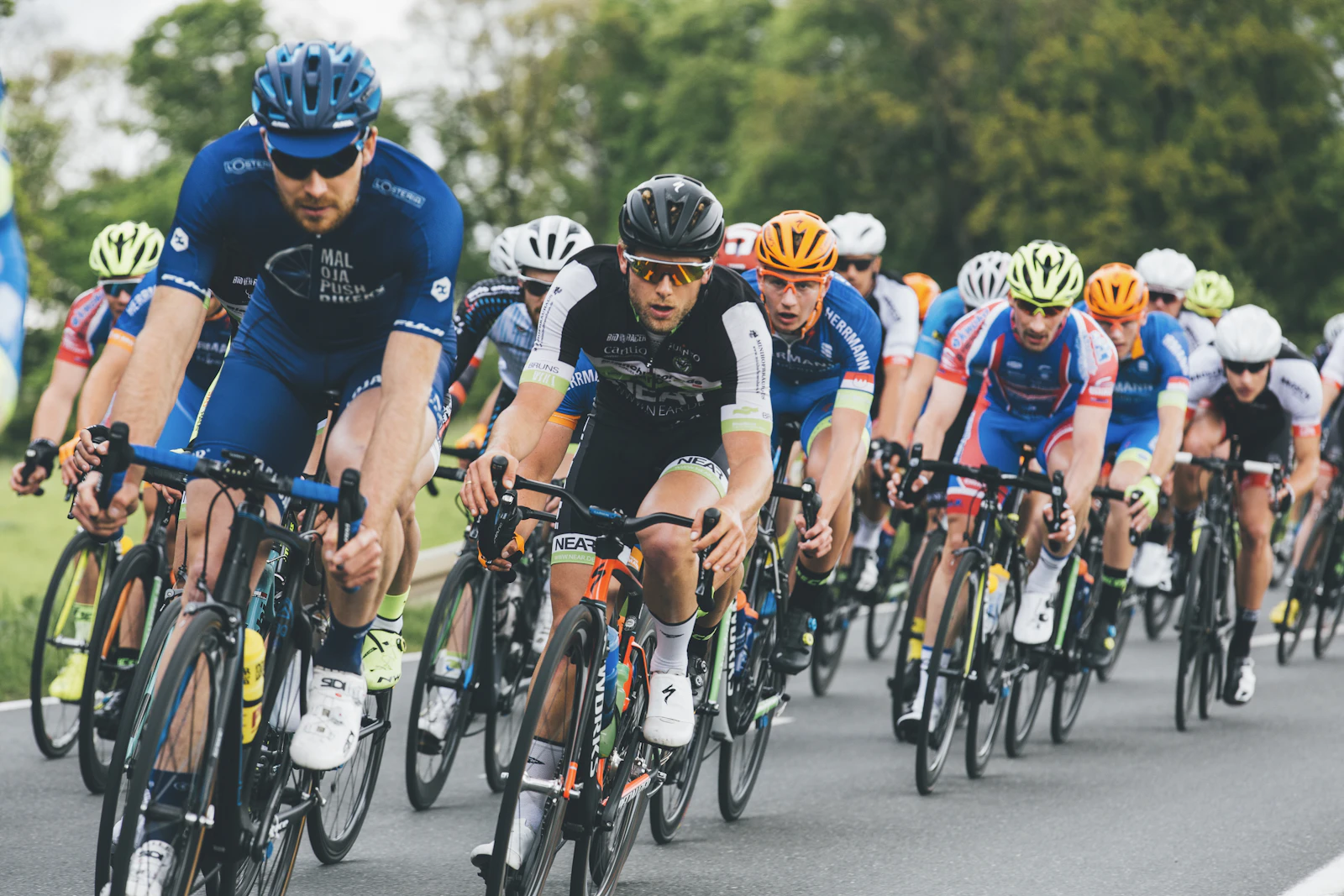
Your first criterium: position, corners and the accordion effect
A crit's average power is often below your FTP, which tells you nothing. What actually decides your first one is where you sit in the bunch — and why the rider at the back is doing a completely different race at the same speed.

Racing abroad: six things that are not like home
The riding is the familiar part. Licences, race manuals, bunch culture, terrain you cannot rehearse, heat and altitude — and the alpine descent that riders underestimate far more often than the climb.

How to pace a time trial with power
The first two minutes decide most time trials, and usually badly. How to pick a target, why even pacing wins on flat courses but not hilly ones, and how to spend your energy above threshold deliberately.

From zero to your first 100 km: a beginner's roadmap
A hundred kilometres feels huge until you have a plan. Here's a friendly, week-by-week roadmap that takes a new rider from short spins to a confident first century.

Climbing in a bunch: where to sit before the road goes up
The climb rarely loses the race; the two kilometres before it do. Why drafting fades as the road steepens, what the surge at the base costs in W′, and where to be when it starts.

How a breakaway actually works (and how to be in the right one)
Four riders should not be able to hold off sixty, and yet it happens every weekend. The drafting arithmetic that explains it, how to read which move has the right riders in it, and the through-and-off technique that keeps a group alive.

Pre-race openers: the day-before session that wakes your legs up
Complete rest the day before an event often leaves you feeling flat. What an opener session does, what it should look like, and how long before the start it's worth doing.

How to peak twice in one season
A taper buys you a window of a couple of weeks, not a summer. How long a peak really holds, what the mid-season rebuild between two targets looks like, and the minimum spacing that makes two peaks realistic.

How to build a sprint that actually wins things
Almost every race finishes in a scramble, and the sprint is the least-trained quality in amateur cycling. The four phases, five sessions, and the recovery mistake that ruins most of them.

Drinking too much: hyponatraemia and why more water isn't safer
It looks like dehydration, it is treated the opposite way, and drinking more makes it worse. Who exercise-associated hyponatraemia actually happens to, why salt tablets are not the answer, and the symptoms that mean call for help now.