The Moveee team
Free coaching · a real route for every ride
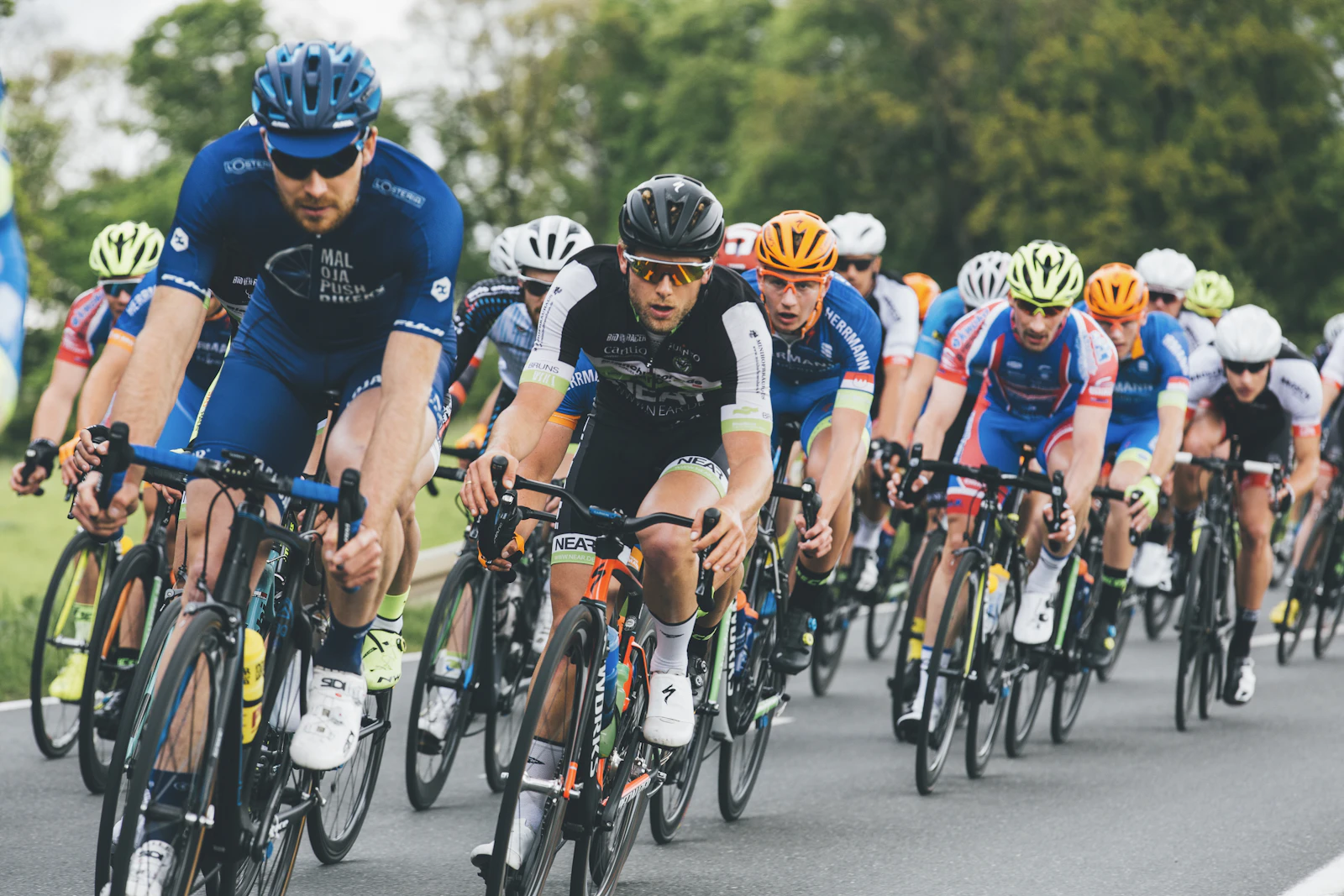
A criterium is the most accessible form of bike racing there is: a short circuit, closed roads, 30 to 60 minutes of riding, and you are never more than a couple of minutes from the finish line. It is also, for a rider whose experience is solo training and the occasional group ride, an unusually intense first taste of racing.
The good news is that most of what decides your first crit is not fitness. It is position, cornering and a handful of habits that take one race to learn and are much easier to learn deliberately than by accident.
Why a crit is harder than its average power suggests
Look at the power file from a criterium and the average will often be unremarkable — perhaps below your FTP. This tells you almost nothing, because a crit is not an average. It is several hundred short, hard accelerations out of corners with brief recoveries between, repeated until the finish.
That is a repeatability problem, not an endurance one. The physiological quality being tested is how many times you can go deep and come back, which is exactly what 30/30 intervals and W′ and anaerobic capacity are about. If you have trained only long steady efforts, the first ten minutes will be a shock.
The anatomy of one lap
Corner entry
Coasting or brakingEveryone slows. This is where positions are won and lost, because the rider on the inside comes out first.
Brake before the corner, not in it. Pick your line early and hold it — moving unpredictably mid-corner is what causes crashes.
Corner exit
Well above thresholdThe bunch accelerates back to speed. At the back, that acceleration is far harder than at the front.
Start pedalling as soon as the bike is upright. Being a bike length late costs you three lengths by the next corner.
The straight
Near threshold, shelteredThe only part of the lap that feels like normal riding. It is also short.
Recover, look ahead, and move up if there is a gap. Do not use it to daydream — the next corner arrives quickly.
The last two laps
Everything you have leftSpeed rises, gaps close, and the bunch gets nervous and wide.
Decide before the bell whether you are contesting the finish or riding it safely home. Both are fine; drifting between the two is not.
The accordion effect is the thing to understand before your first race. When the front of the bunch slows for a corner, the slowing propagates backwards and amplifies — so the front eases, the middle brakes, and the back stops. Then the front accelerates, and the back has to accelerate far harder to close the gap that just opened. Do that forty times and the rider at the back has done a completely different race from the rider at the front, at the same average speed.
Stylised, but every rider who has moved from the back to the front of a crit recognises the shape immediately.
Four rules that matter more than fitness
The single most useful rule in criterium racing. At the front you accelerate once per corner; at the back you accelerate hard, out of every corner, at the end of a whip that has already stretched. Riders do not get dropped from crits because they are unfit — they get dropped because they were twentieth wheel.
Braking mid-corner stands the bike up, moves you across your line and terrifies whoever is behind you. All the slowing happens on the straight before the turn.
Not at the wheel in front, and definitely not at whatever just went wrong. You steer where you look, which is why target fixation puts riders into the one thing they were trying to avoid.
Predictability is the whole social contract of a bunch. You are allowed to be slow, nervous or in the way. You are not allowed to be surprising.
If bunch skills are new to you, do not learn them in a race. Group riding skills for beginners covers holding a wheel, pointing out hazards and moving through a group — all of which are assumed knowledge on the start line.

What to take, and the warm-up
A clean, checked bike
Quick releases tight, bars tight, bottle cages not rattling. Most clubs run a bike check and will send you home for a loose headset.
One bottle, not two
A 40-minute crit needs a mouthful. A second bottle is weight and one more thing to eject into the bunch.
Race licence and pinned number
Pin it flat, four corners plus the middle. A flapping number is drag and, in some races, a warning.
A proper warm-up
Crits start at full speed. Arriving cold and hoping to ease in is how a first race ends in the first three laps — see our openers article.
The warm-up is the part first-timers most often get wrong, because the instinct is to save energy. A criterium's hardest minute is usually its first: the bunch goes from standing to full speed while you are still finding your pedals. Twenty minutes of building effort with two or three short openers means the first lap costs you far less — pre-race openers has the detail, and it applies the day before too.
Preparing for one without a bunch to practise in
You cannot rehearse cornering alone, but you can rehearse the effort pattern, and that is the half most riders neglect. A session of repeated 20–40 second surges from a tempo baseline, with short recoveries, is a fair imitation of what a crit lap does to your legs — and the specific quality you want is being able to produce the fifteenth surge as well as the second.
Moveee Indoor runs that kind of workout in a browser tab: the trainer steps through the surges and the recoveries automatically, so you can concentrate on holding the target rather than on a stopwatch. The ride saves with full power streams, so you can see exactly where the repeatability ran out — which is the number that decides your race.
Finally: your first one is a reconnaissance
Enter, start at the front, sit in, and finish. Do not attack, do not contest the sprint, do not chase a move that you could not have seen coming. A first criterium where you sat safely in the bunch and came home upright has taught you more than a heroic one where you spent four laps off the front and then got dropped — and it means there will be a second.
Sources 5
Where this article summarises a study, the study itself is linked — not a write-up of it.
- 1 Ebert TR, Martin DT, Stephens B, Withers RT Power Output During a Professional Men's Road-Cycling Tour · International Journal of Sports Physiology and Performance · 2006
- 2 Menaspà P, Quod M, Martin DT, Peiffer JJ, Abbiss CR Physical Demands of Sprinting in Professional Road Cycling · International Journal of Sports Medicine · 2015
- 3 Skiba PF, Chidnok W, Vanhatalo A, Jones AM Modeling the Expenditure and Reconstitution of Work Capacity above Critical Power · Medicine & Science in Sports & Exercise · 2012
- 4 Bishop D Warm Up I: Potential Mechanisms and the Effects of Passive Warm Up on Exercise Performance · Sports Medicine · 2003
- 5 McGowan CJ, Pyne DB, Thompson KG, Rattray B Warm-Up Strategies for Sport and Exercise: Mechanisms and Applications · Sports Medicine · 2015
Plan backwards from your event
Give Moveee your event date and it works back from it — the long rides where they belong, the sharpening in the right week, and a taper that arrives on time. It adapts when you miss a session, because you will.
Plan my eventKeep reading

Cornering under pressure: the racing lines nobody practises
A bad corner costs you twice: once in it, again on the exit. The physics of lean and grip, where to look, how to countersteer on purpose, and the race-day corners you can only learn by doing.

Pre-race openers: the day-before session that wakes your legs up
Complete rest the day before an event often leaves you feeling flat. What an opener session does, what it should look like, and how long before the start it's worth doing.

After the crash: what to check, when to ride again
Head first, then neck, then everything else. What the concussion consensus, the UCI protocol and the fracture literature say about getting back on the bike, and why a doctor decides.

Racing abroad: six things that are not like home
The riding is the familiar part. Licences, race manuals, bunch culture, terrain you cannot rehearse, heat and altitude — and the alpine descent that riders underestimate far more often than the climb.

Your first track session: the boards, the fixed gear and the rules
No brakes, no freewheel, and a line painted on the boards that decides where you are allowed to ride. What an accreditation session involves, the two road-rider habits that catch everyone out, and why the banking holds you up.

Your first road race: what actually happens, and how to not get dropped
A road race is not a hard group ride — it's several hundred surges with recoveries you don't control. What the power profile of a bunch race looks like, why the first ten minutes hurt most, and how to prepare for it.
Your first century: 100 miles, and how to arrive with legs left
Build the long ride to about 120 km, ride the first two hours slower than feels necessary, eat from the first hour and sit in the group. A race-prep guide to 161 km that finishes well rather than merely finishes.

The warm-up, matched to the ride you're about to do
The shorter and harder the effort, the longer the warm-up — and vice versa. Four protocols, from a 10-minute roll-out to a full pre-race routine, plus what to stop doing beforehand.

Your first cyclocross race: 60 minutes of the hardest fun in cycling
An hour of starting, surging and running with your bike on your shoulder, in the mud, in November. What the power profile of a lap actually looks like, the three skills that beat fitness, and how little kit you really need for race one.

Climbing in a bunch: where to sit before the road goes up
The climb rarely loses the race; the two kilometres before it do. Why drafting fades as the road steepens, what the surge at the base costs in W′, and where to be when it starts.

From zero to your first 100 km: a beginner's roadmap
A hundred kilometres feels huge until you have a plan. Here's a friendly, week-by-week roadmap that takes a new rider from short spins to a confident first century.

Fuelling six days back to back
On one long ride, fuelling decides how you feel at the end. On six consecutive long rides it decides whether the week produces fitness at all. The daily rhythm, four traps, and why day four feeling grim is often a food problem wearing a training problem's clothes.