The Moveee team
Free coaching · a real route for every ride
Racing in another country is one of the best things you can do with a bike and involves a set of problems that have nothing to do with fitness. The riding is the familiar part; everything around it is not.
Six things that are not like home
Many European events require a national federation licence or a day licence bought in advance, and some require proof of medical insurance or a medical certificate. This is the item most likely to stop you starting, and the one that cannot be fixed on the morning.
Neutralised starts, rolling closures, commissaire cars, feed zones with rules about where you may take a bottle. If the race manual is in a language you do not read, translate it properly rather than skimming — the rules you break are usually the ones you did not know existed.
Groups in different countries have different norms about how close riders sit, how much contact is normal and how much shouting accompanies it. None of it is hostile; it is just unfamiliar, and the first 20 minutes is not the time to be surprised.
A 20-minute climb is a different event from anything on British or Dutch roads, and descending one at speed is a skill rather than a rest. Riders arrive fit for the climbing and unprepared for the descent.
Southern European summer racing is frequently decided by heat tolerance rather than fitness, and a race at 1,800 m will feel wrong in a way you have not experienced.
Whether the road is fully closed, which side you may pass a car, what a whistle means. Ask locally, and watch what the experienced riders do in the neutral section.
Requirements vary by country, by federation and by year, so the only reliable source is the organiser's own race manual plus your national federation — not a forum post from three seasons ago. Read both properly, and do it early enough that a missing document is solvable.
The descent is the thing riders underestimate
If your local riding tops out at five-minute climbs, a 20-minute alpine descent in a bunch at 70 km/h is a genuinely new experience — and unlike the climb, it punishes inexperience immediately. Hairpins, changing surfaces, cold air after a hot climb, tired hands on the brakes.
Practise before you go, on the longest descents you can find, and be entirely willing to let a group ride away from you. How to descend faster and safer covers the technique. Nobody wins a race on a descent; several people lose their season on one.

Preparing for terrain you do not have
The specific problem for a rider from a flat country is that a 45-minute climb cannot be rehearsed outdoors. Generic threshold work helps and does not prepare you for what 45 unbroken minutes at tempo on a gradient actually feels like — there is no freewheeling, no variation, and no opportunity to change position.
Riding the actual climb indoors is the closest available substitute. Moveee Indoor rebuilds a saved route as a 3D road in a browser tab with the trainer following the real gradient, so you can ride the event's decisive climb repeatedly through the spring — learning the pacing, the gearing and where it kicks. Previewing a race course indoors covers it, and gearing for climbing is the thing to sort out before you fly rather than after.
Heat and altitude
A summer race in southern Europe is frequently a heat event wearing a bike race's clothes, and northern riders arrive unprepared for it as a matter of routine. Two weeks of heat adaptation before you travel is one of the highest-return preparations available — heat training for cyclists covers the protocol and racing in the heat covers the day itself.
Altitude is the other one. Above roughly 1,500 m your sustainable power falls, and the correct response is to ride to feel and to power targets adjusted downwards rather than to the numbers you trained at. Riders who insist on their home threshold at 2,000 m find out about it on the second climb.
Logistics
Getting there with a working bike and a functioning stomach is most of the battle — travelling with a bike and eating abroad and stomach trouble are the two companion pieces, and the week's sequencing is in event week logistics.
Arrive at least two days early if you possibly can. It gives you a day to build and test the bike, a ride to shake out the travel, and time to find the start — and it turns the event from something you barely made into something you were ready for.
The part worth remembering
You will almost certainly not get the result you would get at home, and that is not the point. Racing on unfamiliar roads, in a bunch that shouts in a language you do not speak, up a climb you have wanted to ride for years, is one of the genuinely great experiences in amateur sport. Prepare properly so that the day is about the riding — and then be entirely relaxed about where you finish.
Sources 5
Where this article summarises a study, the study itself is linked — not a write-up of it.
- 1 UCI Regulations (Part I: General organisation of cycling as a sport — licences) · Union Cycliste Internationale · 2026
- 2 Clark SA, Bourdon PC, Schmidt W, et al. The effect of acute simulated moderate altitude on power, performance and pacing strategies in well-trained cyclists · European Journal of Applied Physiology · 2007
- 3 Wehrlin JP, Hallén J Linear decrease in VO2max and performance with increasing altitude in endurance athletes · European Journal of Applied Physiology · 2006
- 4 Racinais S, Alonso JM, Coutts AJ, et al. Consensus recommendations on training and competing in the heat · Scandinavian Journal of Medicine & Science in Sports · 2015
- 5 Périard JD, Racinais S, Sawka MN Adaptations and mechanisms of human heat acclimation: applications for competitive athletes and sports · Scandinavian Journal of Medicine & Science in Sports · 2015
Build a route that is actually worth riding
The Route Engine works from real surface and elevation data and favours quiet roads, so it finds the lanes a fastest-way-there app routes you straight past. Give it a distance and a direction and it does the rest.
Build a routeKeep reading

Racing in the cold and wet: staying warm enough to still be racing
Cold rain ends races for riders who were fit enough to finish them, and it usually does it on the descent rather than the climb. Losing your hands before you lose your legs, and the clothing decisions that are really race decisions.

Riding the Étape or the Marmotte: what the profile doesn't show
Both profiles are accurate and both hide the things that end riders' days: altitude on the Galibier, three climates, a 47 km descent, cut-offs, tunnels and feed queues. Official figures throughout.

Pre-race openers: the day-before session that wakes your legs up
Complete rest the day before an event often leaves you feeling flat. What an opener session does, what it should look like, and how long before the start it's worth doing.

The pre-event mechanical checklist, by when to do it
Mechanical problems ruin more amateur events than fitness does, and nearly all of them were visible days earlier. Organised by timing, because most of these checks are useless on race morning — not because they do not matter, but because by then you cannot act on them.

Climbing in a bunch: where to sit before the road goes up
The climb rarely loses the race; the two kilometres before it do. Why drafting fades as the road steepens, what the surge at the base costs in W′, and where to be when it starts.

Your first road race: what actually happens, and how to not get dropped
A road race is not a hard group ride — it's several hundred surges with recoveries you don't control. What the power profile of a bunch race looks like, why the first ten minutes hurt most, and how to prepare for it.
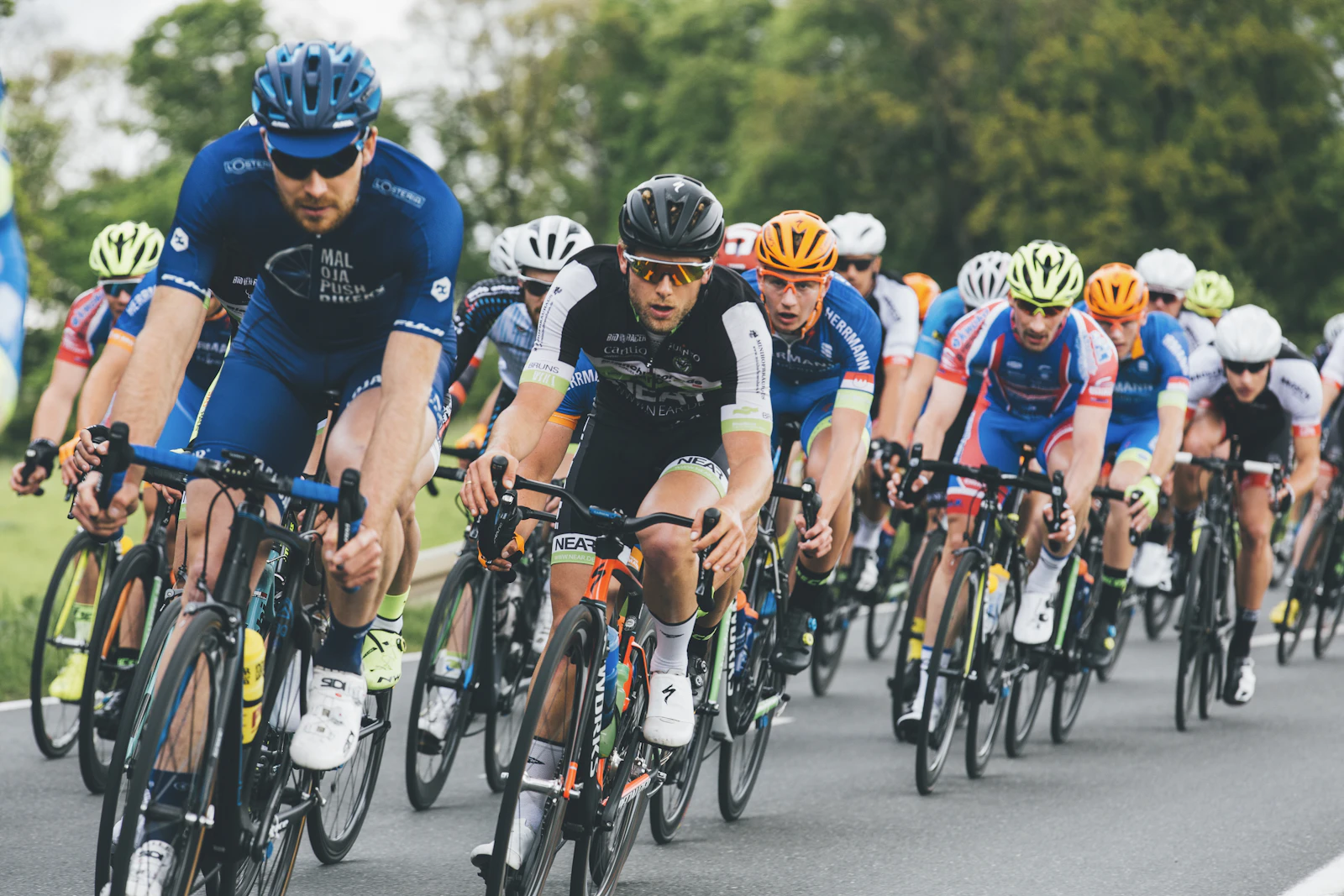
Your first criterium: position, corners and the accordion effect
A crit's average power is often below your FTP, which tells you nothing. What actually decides your first one is where you sit in the bunch — and why the rider at the back is doing a completely different race at the same speed.

Gravel racing: how it's different, and what to train for
Longer, lonelier and far more variable than a road race, with no feed zones and no team car. Why durability beats a sprint, how to fuel when nobody is handing you anything, and the tyre decision that ends more races than fitness does.

Ultra-distance racing: sleep, pacing and the first 24 hours
Past about a day, the limiter stops being your legs. Sleep strategy and what deprivation actually costs you, pacing far below threshold, and the saddle and nerve problems that end more ultras than fitness ever does.
Your first cyclocross race: 60 minutes of the hardest fun in cycling
An hour of starting, surging and running with your bike on your shoulder, in the mud, in November. What the power profile of a lap actually looks like, the three skills that beat fitness, and how little kit you really need for race one.

How to build a sprint that actually wins things
Almost every race finishes in a scramble, and the sprint is the least-trained quality in amateur cycling. The four phases, five sessions, and the recovery mistake that ruins most of them.
RPE: the cheapest, most underrated measurement in cycling
A number you say out loud after a ride tracks training load about as well as a power meter does, and catches things power cannot see — heat, illness, the fatigue you have been ignoring. How to calibrate your own scale so it means something.