The Moveee team
Free coaching · a real route for every ride
Everesting is brutally simple to describe: pick one climb and repeat it until you've ascended 8,848 m — the height of Everest — in a single activity. No sleep, no time limit, one hill. Since lockdowns normalised riding enormous distances in garages, the virtual version — vEveresting — has become a fixture too, with official rules maintained by Hells 500, the movement's founders. Check their current specifics before an attempt you want ratified; the summary here covers the spirit, not the fine print.
- The task: one climb, repeated, 8,848 m of ascent in one activity. Indoors: same idea on a virtual climb, under the official vEveresting rules.
- The reality: for most riders it's a 12–18 hour day. Pacing and eating decide it far more than fitness on the day.
- The prerequisite: months of base and genuinely comfortable 5–6 hour rides — not hero numbers, just a deep, boring foundation.
Is indoors harder or easier? Honestly: both
The folklore says indoor Everesting is harder because "there are no descents to recover on". That's half wrong — the descents are exactly where the recovery happens, indoors and out. What actually differs is how the virtual descent is handled. Outdoors you freewheel down at speed, cold and gripping the brakes. Indoors, depending on the platform and the rules you're riding under, you either spin gently down the virtual descent, use a course that turns you around, or take the descent as near-zero-power soft-pedalling. Either way you're still on the bike, still turning legs, and the descent takes longer at trainer speeds than a real 60 km/h plunge — so the ratio of pedalling to coasting is genuinely worse indoors. That part of the folklore holds.
Everything else tilts the other way. The nutrition table is at your elbow instead of in a car boot. There's no weather window to gamble on, no traffic, no darkness, no descent crash risk at hour fourteen, and a toilet ten steps away. You can hold a perfectly steady power in a way no real hairpinned climb allows. Most riders who've done both call the indoor version mentally harder and logistically far easier — which is a trade you can prepare for.
The maths: reps, VAM and the length of your day
Two numbers define the attempt. First, metres gained per rep — the climb's length times its gradient. Second, your VAM (vertical metres climbed per hour), which sets how long the whole thing takes. All figures below are approximate worked examples:
How many reps? Three example climbs
| Climb type | Example | Reps to 8,848 m |
|---|---|---|
| Short & steep | 2 km at 10% → ~200 m/rep | ~45 reps |
| Classic mid-length | 5 km at 8% → ~400 m/rep | ~23 reps |
| Long alpine | 12 km at 7% → ~840 m/rep | ~11 reps |
How long? Total time at three climbing rates
A sustainable all-day effort for a fit rider — but the clock becomes the opponent.
The realistic sweet spot for most successful attempts.
Sustaining 1,000 VAM for nine hours is genuinely elite territory.
"Door-to-door" adds virtual descents, food stops and faff — which reliably eat 20–35% on top of pure climbing time. Your day will be longer than the maths says. Everyone's is.
Climb choice is a real decision. A steeper climb gains height more time-efficiently but demands low-cadence grinding for hours — brutal on the knees and back. A gentler gradient is kinder but stretches the day. Most successful indoor attempts settle around 6–9% gradients, ridden at a deliberately boring pace: if the first rep feels comically easy, your pacing is roughly right.
It's an eating contest with pedalling attached
Past a certain fitness level, Everesting attempts are decided by the gut, not the legs. You'll burn many thousands of calories, and the limiting factor is how much you can absorb while riding: aim for the trained ceiling of roughly 60–90 g of carbohydrate per hour, every hour, from the very first hour — bottles, gels, rice cakes, real food in rotation before sweetness fatigue sets in. Add sodium throughout; over a 15-hour sweat-fest indoors, plain water alone is a cramping, hyponatraemia-flavoured mistake. The rule that matters: never ride into a deficit and plan to eat your way out later. By the time you feel hollow, you're already two hours behind. And rehearse all of it on long training rides first — attempt day is the wrong time to discover a gel disagrees with you.
Setting up the cave for a 15-hour day
Two fans, minimum
One on the torso, one on the head/back. Cooling is the difference between a hard day and a failed one — indoors there's no 40 km/h descent breeze to rescue you.
Towels and a mat
You will produce a genuinely absurd amount of sweat over 12+ hours. Protect the bike's headset and the floor; swap towels every couple of hours.
Saddle-pressure plan
Chamois cream, a spare pair of bib shorts to change into halfway, and deliberate out-of-saddle breaks every rep. Saddle sores end more attempts than legs do.
Entertainment strategy
Music for the dark hours, podcasts for the middle, something engaging for the start. Plan it like the nutrition — boredom at hour nine is a real DNF cause.
Spares within reach
Charged head unit and phone, spare batteries, chain lube, snacks pre-portioned. Every dismount should be a choice, not an emergency.
A support human (ideally)
Someone to refill bottles, hand up food and talk you through the 6,000 m wobble. Solo is possible; supported is far more likely to finish.
Are you ready to attempt it?
Good news first: you don't need pro numbers, and you don't need mythical 10,000-metre climbing weeks in training — nobody sensible prepares that way. What you need is a deep, unglamorous base and proof that your body tolerates very long days. Honest benchmarks before you pencil in a date:
Comfortable 5–6 h rides
Not survived — comfortable. If a long Sunday ride still wrecks you for days, the attempt will find that out at hour seven.
Big single-day climbing done before
A 3,000–4,000 m day teaches you how your body behaves deep into vertical. Don't let attempt day be your first visit.
A practised gut
You must have rehearsed eating 60–90 g of carbs per hour on long rides. Race-day nutrition experiments are how attempts end in a bucket.
A real base, not a monster one
You do not need 10,000 m climbing weeks. Months of consistent riding with regular long days is the actual prerequisite.
One safety line that belongs in every Everesting article: a 12–18 hour maximal day is a serious physiological event. Build up to it over months, don't attempt it ill or sleep-deprived, and treat quitting at 6,000 m as data for the next attempt, not failure. The mountain doesn't move.
Pick a climb worth marrying for a day
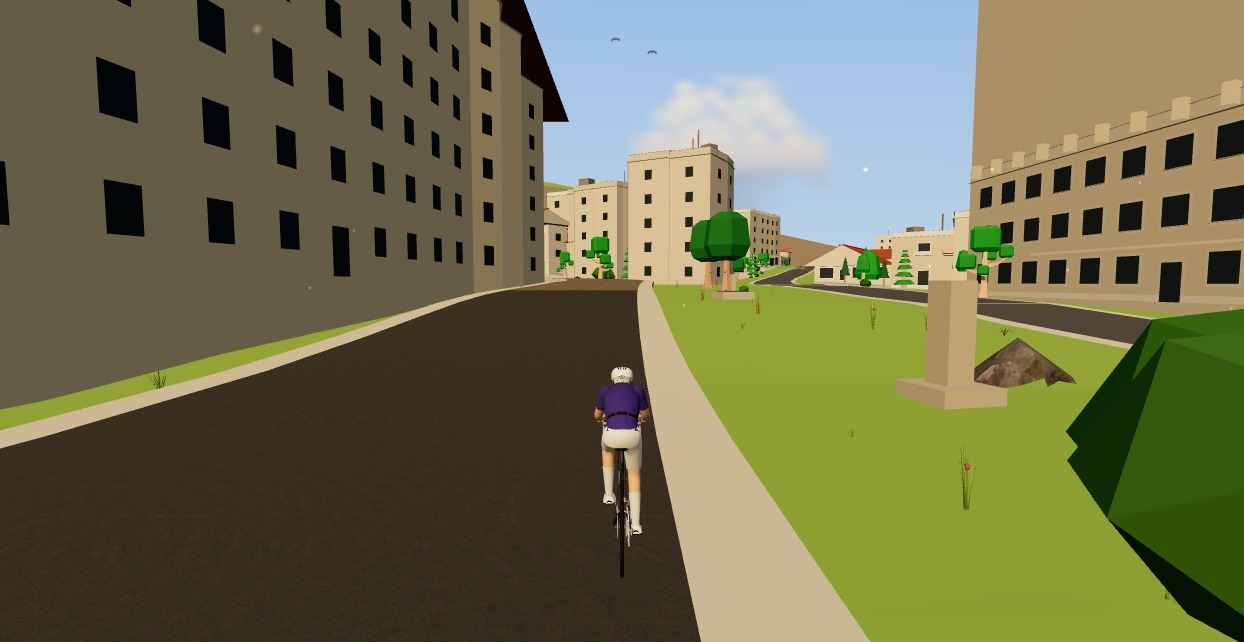
You're going to see this climb forty times. Make it one you care about. In Moveee Indoor you can load a real famous climb — or any climb you love — as a GPX route and ride it in a 3D world built from the actual road and elevation data, in your browser, with your trainer's resistance tracking every gradient change. Alpe d'Huez reps, your local col, the climb from a race you dream about: pick one, and every lap is the real profile of a real road, saved straight to Strava when the long day is finally done.
Sources 6
Where this article summarises a study, the study itself is linked — not a write-up of it.
- 1 The Rules · Hells 500 / Everesting · 2025
- 2 Jeukendrup A A Step Towards Personalized Sports Nutrition: Carbohydrate Intake During Exercise · Sports Medicine · 2014
- 3 Jeukendrup AE Training the Gut for Athletes · Sports Medicine · 2017
- 4 Racinais S, Alonso JM, Coutts AJ, et al. Consensus recommendations on training and competing in the heat · Scandinavian Journal of Medicine & Science in Sports · 2015
- 5 Hew-Butler T, Rosner MH, Fowkes-Godek S, et al. Statement of the Third International Exercise-Associated Hyponatremia Consensus Development Conference · Clinical Journal of Sport Medicine · 2015
- 6 Baker LB Sweating Rate and Sweat Sodium Concentration in Athletes: A Review of Methodology and Intra/Interindividual Variability · Sports Medicine · 2017
Your own roads, indoors, in a browser tab
Moveee Indoor pairs your smart trainer over Bluetooth and rebuilds a route you have saved as a 3D road — real gradients, ERG for the intervals, and the ride saved with full power data. Nothing to install. Free while it is in alpha.
Start an indoor rideKeep reading

Hill climb events: eight minutes of honesty
One road, one clock, nowhere to hide — and the one event where power-to-weight genuinely dominates. Pacing by duration, what is worth stripping off the bike and what absolutely is not, and the warm-up mistake half the field makes.
How to preview a race course indoors before you ride it
The best way to know a course is to have ridden it. Here's how to preview a race course indoors — corner by corner, climb by climb — from its GPX file, in 3D, on your smart trainer, weeks before the start line.

Your first cyclocross race: 60 minutes of the hardest fun in cycling
An hour of starting, surging and running with your bike on your shoulder, in the mud, in November. What the power profile of a lap actually looks like, the three skills that beat fitness, and how little kit you really need for race one.
Pacing a gran fondo with power: the first climb is the trap
The purest pacing test in amateur cycling. Target bands by event length, the four rules that decide the day, and why the number that ruins fondos is almost never the average.

Ultra-distance racing: sleep, pacing and the first 24 hours
Past about a day, the limiter stops being your legs. Sleep strategy and what deprivation actually costs you, pacing far below threshold, and the saddle and nerve problems that end more ultras than fitness ever does.

How to ride a hilly sportive you're underprepared for
Four weeks out and short of training? The fitness is what it is — but pacing, gearing and fuelling are all still in play, and together they matter more on the day than the training you didn't do.

Climbing in a bunch: where to sit before the road goes up
The climb rarely loses the race; the two kilometres before it do. Why drafting fades as the road steepens, what the surge at the base costs in W′, and where to be when it starts.

Racing in the cold and wet: staying warm enough to still be racing
Cold rain ends races for riders who were fit enough to finish them, and it usually does it on the descent rather than the climb. Losing your hands before you lose your legs, and the clothing decisions that are really race decisions.

Race day nutrition plan: hour by hour
Breakfast, the hour before, the start, and every hour after that. A concrete fuelling timeline for a two-hour race and a six-hour one, with the carbohydrate and fluid numbers the research supports.

From zero to your first 100 km: a beginner's roadmap
A hundred kilometres feels huge until you have a plan. Here's a friendly, week-by-week roadmap that takes a new rider from short spins to a confident first century.

The week before: everything that is not training
The physiology of the taper is a solved problem. This is the other half — admin, travel, packing and the sequence of small decisions that decides whether you reach the start line calm or already tired.
How to train indoors: turning trainer time into real fitness
An hour on the trainer can be worth ninety minutes on the road — or completely wasted. Here's how to structure indoor sessions so every minute you spend in the pain cave counts.