
The Moveee team
Free coaching · a real route for every ride
If you've ever gone looking for an indoor cycling app you can simply open and ride — no launcher, no 12 GB download, no waiting on an update the one evening you actually have a free hour — you'll have noticed how few of them exist. The well-known names are almost all installed, native applications. That isn't laziness on their part, and it isn't an accident. For most of the last decade, a browser genuinely couldn't do the job.
Two things have changed that, quietly, over the past few years. What follows is an honest survey of what a browser-based indoor cycling app can be in 2026 — which of the familiar platforms actually let you ride in a tab, which only park a dashboard there, and where the one we build fits in. We'll flag our own product plainly when we reach it.
Why almost nothing ran in a browser — until now
To run indoor cycling in a browser you need two hard things at the same time: a way to talk to a smart trainer over Bluetooth, and a way to draw a convincing, moving world without dropping frames. Until recently the web could do neither well, so the entire category grew up as native software — installed, updated and tied to a specific machine. Here's what stood in the way, and what came down.
Talking to the trainer
The old wall: Web pages simply couldn't reach Bluetooth hardware. A smart trainer was invisible to a browser tab, so controlling resistance meant a native app.
What opened it: Web Bluetooth lets a Chromium browser pair a trainer, power meter and heart-rate strap directly — no app, no dongle.
Drawing the world
The old wall: A moving 3D world at 60fps was the job of a native game engine. Browsers of the era would have crawled, if they rendered it at all.
What opened it: WebGL hands the browser the GPU. A real, streaming 3D world now runs in a tab that would have needed a full install a few years ago.
Both of those — Web Bluetooth and WebGL — are Chromium technologies. That's the single biggest reason a browser-native cycling app runs in Chrome or Edge but not, yet, in Safari or Firefox: those browsers haven't shipped Web Bluetooth, so a tab there simply can't reach your trainer.
What actually runs in a browser today
Here's the honest distinction most round-ups skip. Nearly every big platform has a web presence — an account page, a workout planner, a stats dashboard. That is not the same as riding in the browser. On most platforms the web is where you plan and review; the ride itself still happens inside an installed app. Only one row below lets the whole ride run in a tab.
| Platform | What's on the web | Ride in the browser? | The honest note |
|---|---|---|---|
| Zwift | Companion + web stats | Native app | Windows, macOS, iOS, Android, Apple TV — installed to ride. |
| TrainerRoad | Web planner & calendar | Native app | Plan and analyse on the web; the workout itself runs in the app. |
| Rouvy | Web account | Native app | AR video over real roads; a native app plays the ride. |
| MyWhoosh | Web account | Native app | Free 3D world — but you download the app to ride it. |
| IndieVelo / TP Virtual | Limited | Native app | Racing-first physics; a Windows app to take part. |
| Moveee Indoor Ours | It is the web app | Yes | The whole ride runs in Chrome or Edge — nothing to install. |
Capabilities move fast and platforms add features constantly — this reflects our reading at the time of writing, so check for yourself before you commit. If you want the full field on its own terms, our guide to the best indoor cycling apps ranks them without the browser filter.
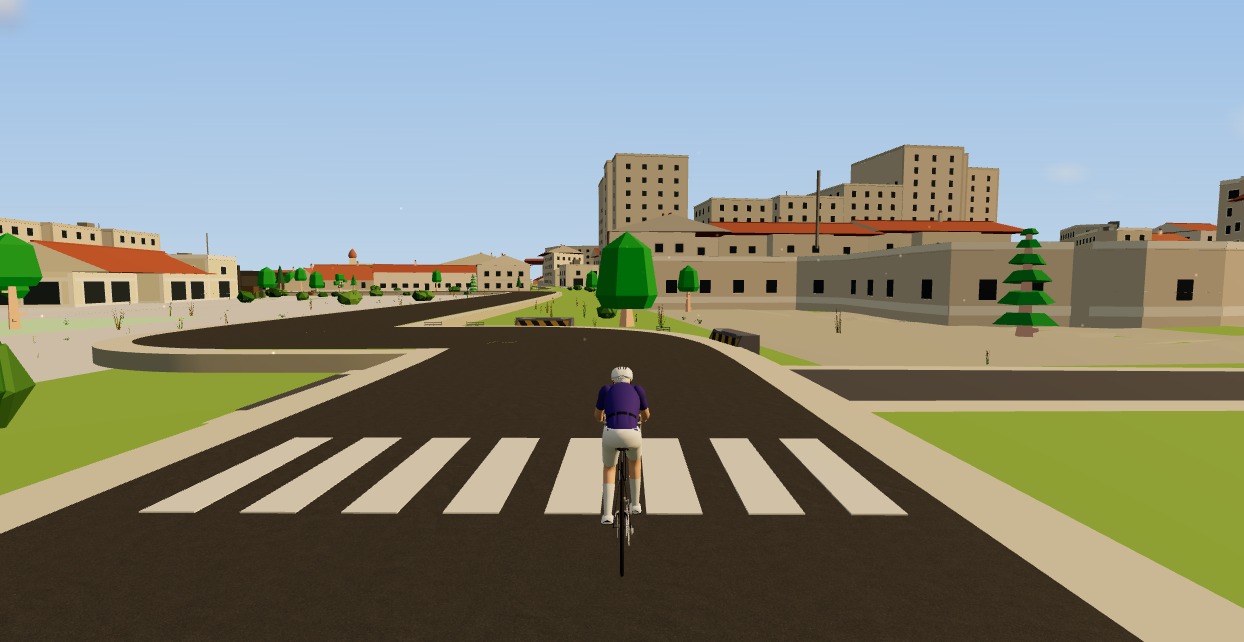
Where Moveee Indoor fits — and yes, it's ours
Full disclosure before anything else: Moveee Indoor is our product. We built it because we wanted the one thing the table above kept not delivering — to open a tab and ride, with no install standing between deciding to train and actually turning the pedals.
So the whole ride is browser-native. You pair a smart trainer (FTMS), power meter (CPS) or heart-rate strap over Web Bluetooth, and ride in Chrome or Edge on Windows, macOS, Linux or Android. The world isn't a fantasy island: it renders your own saved routes in 3D from real OpenStreetMap and elevation data — the actual streets, buildings, bridges and gradients your route passes through. ERG mode works, holding each interval's watts across 150+ structured workouts or your own. And the finished ride saves with full power analysis, lands on your calendar, counts toward your Moveee training plan and publishes to Strava in one tap. If the browser angle specifically is what you're chasing, our companion piece on finding a Zwift alternative that runs in a browser goes deeper on that trade.
It's also the youngest thing on this page, and we'll say so plainly: it's free while in alpha, Chrome or Edge only, and there's no meaningful racing scene yet. Rough edges are part of the deal right now.
Who browser-native suits — and who's better off with a native app
Being fair about this matters more than selling you anything. Browser-native is a genuinely better fit for a lot of riders, and a genuinely worse one for others. Here's the split as we see it.
Browser-native suits you if…
- You share a laptop, or ride on a machine you can't install software on
- You're short on disk space, or sick of a 12 GB download and its updates
- You hop between computers and want your setup to follow you into any tab
- You want to try indoor riding tonight without committing an evening to setup
A native app is the better call if…
- You want a busy racing scene with thousands of riders online at any hour
- You're on an iPhone or iPad, where browser trainer-pairing isn't possible yet
- Your trainer only speaks ANT+ and you rely on a USB dongle to reach it
- You need the ride to keep running with the screen off or the app in the background

The short version
Most of the category is native, for solid historical reasons — Bluetooth and 3D were both once beyond the browser. Both barriers have quietly fallen, which is why a browser-native ride is possible at all in 2026, and why so far only Chromium browsers can do it. For a lot of riders, most of the time, "open a tab and go" is exactly the right amount of app.
If that's you, Moveee Indoor is our take on it — the whole ride in the browser, on your own real roads, free while in alpha, Chrome or Edge. No install, no excuse not to try it for twenty minutes tonight.
Sources 7
Where this article summarises a study, the study itself is linked — not a write-up of it.
- 1 Web Bluetooth — Draft Community Group Report · Web Bluetooth Community Group (W3C) · 2024
- 2 Web Bluetooth API — browser compatibility · MDN Web Docs (Mozilla) · 2025
- 3 Mozilla specification positions (Web Bluetooth: harmful) · Mozilla · 2025
- 4 WebGL Specification 1.0 · Khronos Group · 2011
- 5 Fitness Machine Service 1.0 (FTMS) · Bluetooth SIG · 2017
- 6 Cycling Power Service 1.1 (CPS) · Bluetooth SIG · 2016
- 7 About OpenStreetMap · OpenStreetMap Foundation · 2025
Your own roads, indoors, in a browser tab
Moveee Indoor pairs your smart trainer over Bluetooth and rebuilds a route you have saved as a 3D road — real gradients, ERG for the intervals, and the ride saved with full power data. Nothing to install. Free while it is in alpha.
Start an indoor rideKeep reading
A free MyWhoosh alternative that rides your own real routes
MyWhoosh proved indoor cycling can be free. If you want a free MyWhoosh alternative that rides your own real roads instead of a fictional world — and runs in the browser with nothing to install — here's the honest comparison.
A Zwift alternative that runs in your browser — no download, no install
If you want the Zwift experience without the 12 GB download, the launcher and the gaming PC, the answer now runs in a browser tab. Here's how a no-install alternative works — and where it doesn't.

What a browser-based cycling app can — and can't — do in 2026
Browsers grew up. They can now pair your trainer, render a 3D world and save a ride with full power data. But a few things still belong to native apps. An honest capabilities audit.

Browser vs installed app: why riding indoors shouldn't need a 12 GB download
Installed apps still win on a couple of things — but fewer than you'd think. Here's an honest head-to-head between browser-native and installed indoor cycling, feature by feature.

Indoor cycling on a Chromebook: the trainer apps that actually work
A Chromebook can't install Zwift — but it can still run a full trainer session. Here's how to ride indoors on Chrome OS with nothing to download, and exactly what you need.

Zwift on iPad? A browser alternative for tablets that actually works
Searching for Zwift on iPad — or a lighter tablet alternative? Here's the honest state of indoor cycling on tablets in 2026: what works on an Android tablet in the browser, the real iPad Bluetooth catch, and the simplest setups that just work.

An indoor cycling app for Windows with nothing to install
No admin rights, no 12 GB download, no launcher updating itself before every session. Here's how to run a full indoor cycling app on Windows with nothing to install — a browser tab, your smart trainer, and a real 3D road.
A free FulGaz and Kinomap alternative for real-road rides
FulGaz and Kinomap ride real roads on video. If you want a free FulGaz and Kinomap alternative that rebuilds real roads in 3D — including routes you've drawn yourself — and runs in the browser, here's how it stacks up.
Indoor cycling on any device: how Moveee Indoor runs in the browser (even on a Mac)
Mac, Windows, Linux, a Chromebook or an Android tablet — if it runs Chrome or Edge, it can run a full trainer session. Here's how one browser app rides on all of them, and the one gap (iOS).
A Rouvy alternative for riding real roads indoors
Rouvy put real roads on the trainer with video. If you want a Rouvy alternative that rebuilds real roads in 3D from map data — including your own routes — and runs free in the browser, here's how the two approaches compare.
Can you really train indoors in a browser? How Moveee Indoor works in 2026
"In the browser" used to mean toy-grade. Not any more. Here's how a browser now pairs your trainer, holds your watts and renders a real 3D world — and what still needs a native app.
How to ride a GPX file indoors on your smart trainer
Any route you can export as a GPX file, you can ride indoors. Here's how to turn a GPX into a 3D indoor ride on your smart trainer — with real gradients driving the resistance — straight from your browser, no install.