The Moveee team
Free coaching · a real route for every ride
Almost nobody says "I love the turbo." Plenty of riders say they can't face it, do three sessions in November and never touch it again. That's a shame, because indoor training is the most efficient tool most cyclists have — and the boredom problem is largely solvable.
Here's the thing though: the trainer isn't inherently boring. Riding at an undefined intensity, in silence, staring at a garage wall, with no idea when it ends — that's boring. Fix those variables and the hour changes completely. Twelve things that work, roughly in order of how much difference they make.
Session design
Never ride without a plan
"An hour, quite hard" is the most boring session ever invented. "4 × 8 minutes" has a shape, a countdown and an end. Structure isn't just better training — it's better entertainment.
Make it shorter and harder
Forty-five focused minutes beats ninety aimless ones for both fitness and morale. Indoor time is concentrated; treat it that way.
Count down, not up
Frame reps as "two to go" rather than "three done." It sounds trivial. It genuinely changes how the set feels.
Vary the cadence
Same watts, different rpm. A block at 95 rpm followed by one at 70 rpm feels like two completely different sessions.
What's on the screen
Ride somewhere real
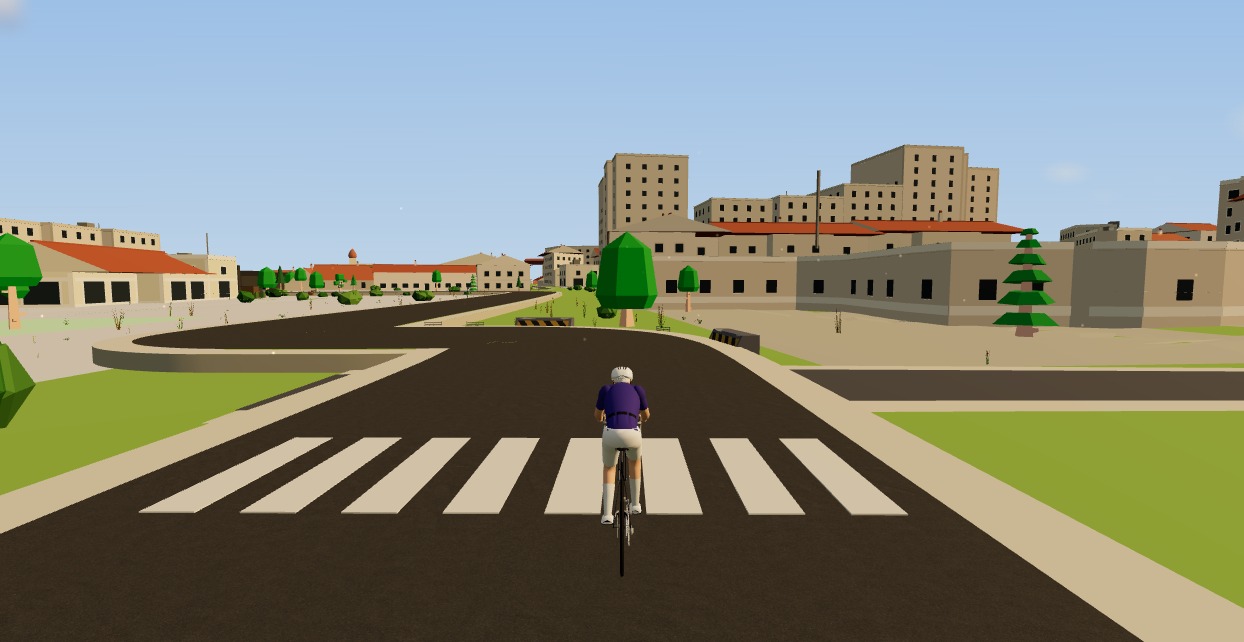
A world built from roads you recognise beats a fictional island — and beats a wall by a mile. Familiar terrain gives the hour a narrative.
Save a series for the trainer
One programme you're only allowed to watch while pedalling. Slightly ridiculous, remarkably effective.
Match the music to the effort
Build a playlist where the big track lands at the start of the last interval. Cheap, and it works every time.
Watch racing
Old classics or a mountain stage. Riding while watching people ride is oddly compelling.
People and stakes
Ride with someone
A friend on a video call, or a virtual group ride. Suffering is far more tolerable when it's shared.
Enter something
A virtual race, a club challenge, a target event in June. A deadline transforms a Tuesday session.
Make the streak the goal
"Three sessions a week until March" is a game you can win. Ticking the box becomes its own motivation.
Give yourself a reason to care
Recon a course you've entered. Ride the climb you're scared of. Purpose beats willpower.

The two that matter most
If twelve is too many to act on, do these two.
First: always have a written session. This is the single biggest lever, and it's free. A structured workout gives you a countdown, a shape and an unambiguous finish line. When you're deep into interval three of four, "one more" is a thought you can hold onto. "Keep going until it's been an hour" is not. Our list of eight indoor workouts that actually make you faster is a reasonable place to start — pick one, write it on a Post-it, stick it on the bars.
Second: put something in front of you worth looking at. The wall is the enemy. Any screen is better than no screen, and a screen showing somewhere you have a personal reason to care about is better still.
Ride somewhere you actually know
This is the angle we took with Moveee Indoor, because it's the version of "somewhere to look" that we found genuinely changed our own winters. Instead of a fictional world, it builds the 3D world from your own saved routes using real map and elevation data — the actual streets, buildings, rivers and climbs of the roads that route follows.
Which means on a wet Tuesday in January you can ride your favourite summer loop, or your commute, or reconnoitre the exact course of the gran fondo you've entered for June — corner by corner, with the real gradients driving your trainer's resistance. Turning "an hour on the turbo" into "the run up to the Vršič hairpins" is a completely different psychological proposition. It runs in your browser with nothing to install, holds your interval targets in ERG mode, and it's free while it's in alpha.
Whether that's your thing or not, the principle stands: give the hour a reason to exist beyond the watts.
And accept that some days are just dull
One honest caveat. Not every trainer session will be enjoyable, and chasing constant entertainment is its own trap — riders who need a race or a new world every single time eventually run out of novelty. Some Tuesdays in February you will simply put your head down, do the work, and be glad it's finished. That's fine. That's training.
The goal isn't to love every session. It's to remove enough friction that skipping it stops being the obvious choice. Structure, a fan, a screen with somewhere real on it, and a reason to care — that's usually enough to carry a rider from November to March. And in March, when everyone else is starting from scratch, you'll be glad you didn't quit in week three.
Sources 6
Where this article summarises a study, the study itself is linked — not a write-up of it.
- 1 Terry PC, Karageorghis CI, Curran ML, Martin OV, Parsons-Smith RL Effects of music in exercise and sport: a meta-analytic review · Psychological Bulletin · 2020
- 2 Karageorghis CI, Priest DL Music in the exercise domain: a review and synthesis (Part I) · International Review of Sport and Exercise Psychology · 2012
- 3 Bird JM, Karageorghis CI, Baker SJ, Brookes DA Effects of music, video, and 360-degree video on cycle ergometer exercise at the ventilatory threshold · Scandinavian Journal of Medicine & Science in Sports · 2019
- 4 Irwin BC, Scorniaenchi J, Kerr NL, Eisenmann JC, Feltz DL Aerobic exercise is promoted when individual performance affects the group: a test of the Köhler motivation gain effect · Annals of Behavioral Medicine · 2012
- 5 Locke EA, Latham GP Building a practically useful theory of goal setting and task motivation: a 35-year odyssey · American Psychologist · 2002
- 6 Rhodes RE, Kates A Can the affective response to exercise predict future motives and physical activity behavior? A systematic review of published evidence · Annals of Behavioral Medicine · 2015
Your own roads, indoors, in a browser tab
Moveee Indoor pairs your smart trainer over Bluetooth and rebuilds a route you have saved as a 3D road — real gradients, ERG for the intervals, and the ride saved with full power data. Nothing to install. Free while it is in alpha.
Start an indoor rideKeep reading

The screen in front of your trainer
Riders spend a fortune on trainers and nothing on what they look at, then wonder why an hour indoors feels longer than three outside. It is an ergonomics problem before it is a hardware one — and sweat is the part that kills laptops.

Disc brake noise: what it means and what to do
Better than rim brakes in nearly every way that matters and worse in exactly one — when they are unhappy they tell you loudly, in front of other people. Diagnosis by sound, the five-minute alignment fix, and the one noise that means stop riding.

Knee pain from cycling: the most common causes and fixes
Where it hurts narrows the cause considerably: front, back and outside of the knee point at different things. What each pattern typically implicates in fit or training load — and what needs a professional.
Your first winter on the bike: kit, roads and staying motivated
Winter is where new riders quietly stop. Warm extremities, lower roads, one hard session a week and a fixed ride day carry more fitness into spring than any jacket.

Indoor cycling on a Chromebook: the trainer apps that actually work
A Chromebook can't install Zwift — but it can still run a full trainer session. Here's how to ride indoors on Chrome OS with nothing to download, and exactly what you need.
Indoor cycling app with no power meter: what you get and what you don't
Both columns side by side. What a speed sensor gives you indoors — the route, distance, heart rate, cadence, a ride that counts — and what it cannot: watts, ERG, TSS, FTP. Including why we refuse to show you a virtual power number.
Speed sensor or smart trainer: when is the upgrade actually worth it?
Four signs you have outgrown a speed-only setup, what power actually unlocks, and three routes compared — including the one most people overlook, which is a power meter rather than a trainer. Plus the honest case for staying where you are.

How to fix a flat in five minutes (and stop dreading it)
A roadside puncture repair, step by step, and the two things beginners skip that turn a five-minute job into twenty: finding the cause, and seating the bead before you pump it hard.

How to export a workout to your Garmin or Zwift (.zwo and .fit explained)
Structured workouts travel as files — .zwo for Zwift, .fit for Garmin and most head units — and once you understand the two formats you can build a session once and ride it anywhere. What each format is, which platforms accept which, and the step-by-step for getting a workout onto every device you own.

Why your hands go numb on the bike (and how to fix it)
Numb fingers are nerve compression, and which fingers go numb tells you which nerve. What causes it, what to change on the bike, and the symptoms that mean stop riding and see a doctor.
The best indoor cycling apps in 2026 (an honest round-up)
Zwift, TrainerRoad, Rouvy, MyWhoosh and the rest — what each one is actually for, what it costs, and how to pick the app that matches how you like to ride indoors.

Fuelling indoor rides: what to eat, drink and when
The physiology isn't different indoors — the conditions are, in four ways that change the numbers. A fuelling table by session length, and why the trainer is the best place to practise race nutrition.