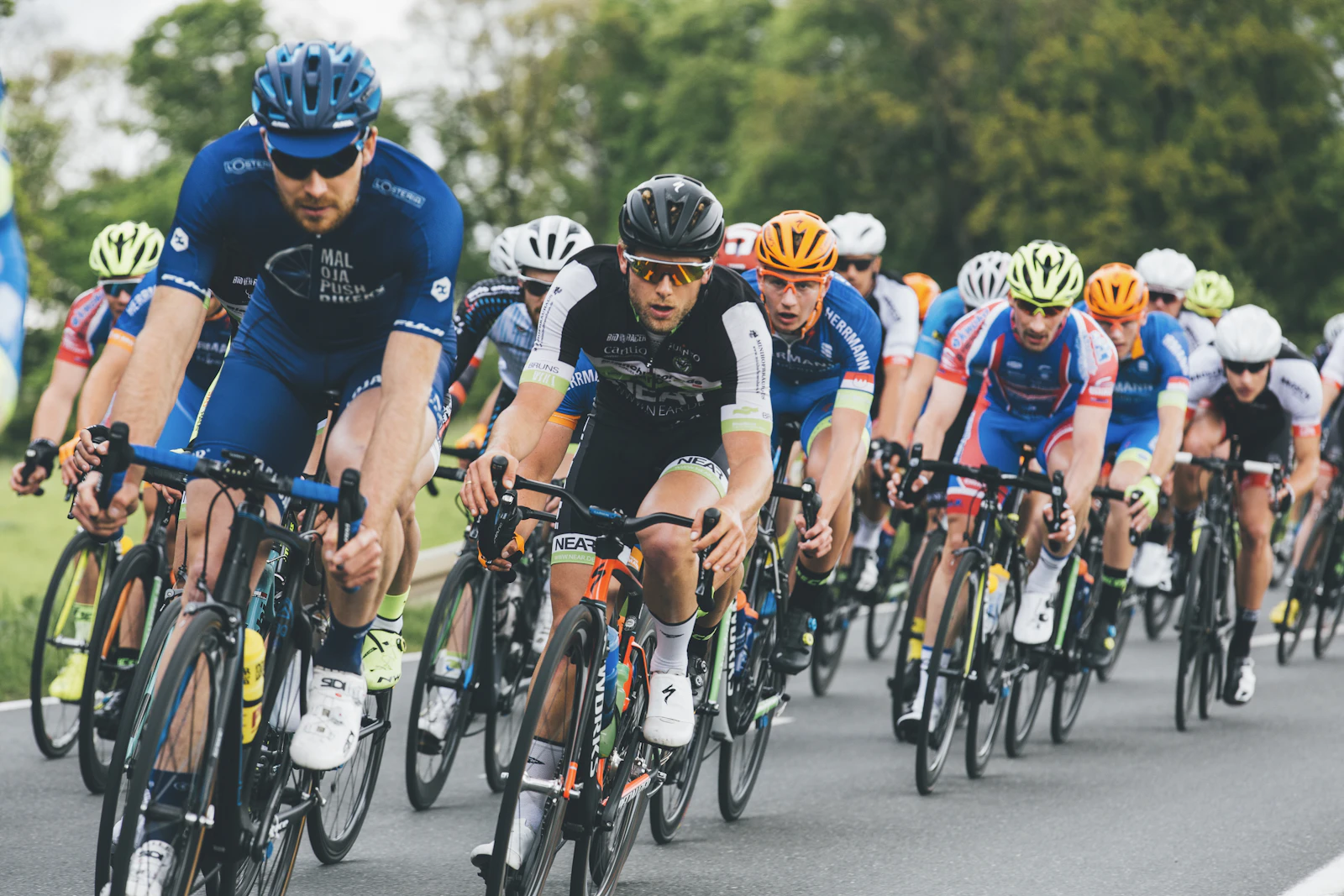
The Moveee team
Free coaching · a real route for every ride
If you started riding this spring, the first winter is where most people quietly stop. Not because they decide to, but because the first cold, dark, wet week arrives and there is no plan for it, and then there is another one. The riders who come out the other side with their fitness intact are not tougher. They have solved three specific problems: they are warm in the places that matter, they ride roads that suit the season, and they have given themselves a reason to go out that survives a grey Tuesday. This post is about those three things, and about what winter riding does and does not do for your fitness.
Cold is a management problem, not a toughness problem
The physiology is well described. Cold air pulls heat from you by convection, and the faster the air moves over you the faster it does so; the wind-chill tables published by the US National Weather Service exist precisely because 5 °C in still air and 5 °C with a 30 km/h wind are not the same thing for skin. On a bike you make your own wind, so a descent at 40 km/h on a 3 °C morning puts your face and hands in conditions that the thermometer does not describe. The American College of Sports Medicine's position stand on cold injury makes the practical points: the extremities lose heat first and fastest, wet clothing loses most of its insulation, and the risk is highest when you stop moving, because heat production drops while heat loss does not.
What that means on the bike:
- Hands and feet before body. Most riders overdress their torso and underdress their extremities. If your core is warm you will sweat, the sweat will cool you, and your fingers will still be numb. Good gloves, overshoes and a headband under the helmet solve more winter misery than any jacket.
- Start slightly cold. If you are comfortable standing still at the door, you are overdressed for the first hill. Aim to be a little chilly for the first ten minutes.
- Plan for the stop. A puncture in December is a different event from one in June. A packable windproof, a spare pair of gloves and a hat in the pocket change how a 15-minute roadside repair ends. Our post on fixing a flat is worth reading before you need it.
- Wet is the enemy, not cold. Rain and road spray at 6 °C are harder than dry air at 0 °C. Mudguards keep the spray off your back and feet, which is why experienced winter riders use them even when they look unfashionable; see mudguards and winter bike setup.
Layering works, but it is not magic. A controlled study of layered garments during rest and exercise at 8 °C found that neither the fabric (wool or polyester) nor the number of layers made much difference to heart rate or core temperature; the differences between fabrics measured in the lab were, in the authors' words, typically overstated compared with what the wearer experienced. Two layers kept the skin warmer than one, which is the part that matters for comfort. Buy a windproof outer, a base layer of whatever fibre you prefer, and stop worrying about the rest. There is a fuller breakdown in cycling clothing explained.
Where the fitness goes, and where it does not
A frequent worry is that winter riding "does not count" because you are slower. It counts. Galloway and Maughan's classic study had cyclists ride to exhaustion at four air temperatures; they lasted longest at about 11 °C, and considerably less at 4 °C and at 31 °C. So a cool day is close to ideal for a long steady ride, and a cold one costs you a little. Riding in the cold also raises energy expenditure somewhat, through shivering and the extra work of moving in heavier clothing, a point the ACSM position stand makes explicitly. That means winter rides need fuel just as summer ones do, and the fact that you feel less thirsty is not a reason to drink less. See hydration in winter.
What winter does cost you, if you let it, is intensity. A season of only slow, cold, well-wrapped rides will keep your endurance and lose your top end. The evidence here is clear enough: in well-trained cyclists, keeping a small dose of high-intensity work through the off-season preserved performance that a low-intensity-only group lost, and the group that kept the intensity was ahead when the next season started. You do not need much. One short hard session a week, indoors if the roads are too grim, holds most of it.
That is where a trainer earns its place. Not as a replacement for winter riding, but as the place you do the one session that would be unpleasant or unsafe outside. If you have a smart trainer, Moveee Indoor runs in Chrome or Edge with nothing to install and will hold you at a target power in ERG mode; if you have a plan built in Moveee, the session is already on the calendar and you just start it.
Roads change in winter
The route you loved in July may be a bad idea in January. Three things to look for:
- Shade and altitude. Frost survives all day on shaded north-facing lanes and in valley bottoms while the sunny side is dry. Descents through woods are the classic place to find black ice at midday. Lower, more open roads are safer in freezing weeks.
- Surface. Winter roads carry grit, leaves, mud from fields and standing water that hides holes. Give yourself more room, brake earlier and ride a little wider tyre at a little lower pressure if your frame allows.
- Light. Short days mean a ride that started in daylight can end in dusk. Research on cyclist conspicuity is unflattering: riders reliably overestimate how visible they are at night, and reflective material on the moving parts (ankles and knees) does far more for recognition than a reflective jacket. Run lights front and rear from the start of any afternoon ride, and read riding at night.
We wrote about designing routes for the season in winter route design. The short version: shorter loops close to home, so that a change in the weather or a mechanical is a ten-minute problem, not an hour-long one.
Motivation: the part nobody plans for
This is the bit that actually decides whether you are still riding in March. The research on sticking with exercise points the same way from several directions.
First, motivation that comes from inside (you ride because you enjoy it, or because being a rider is part of how you see yourself) predicts long-term adherence far better than motivation that comes from outside (you ride because you think you should, or because someone told you to). A large review of self-determination theory in exercise found this consistently. The practical consequence is that winter is the wrong time to force yourself through sessions you hate. Ride the way you like riding; save the discipline for the one hard session a week.
Second, habits form through repetition in a stable context, and take longer than the "21 days" folklore suggests. In one field study people took a median of around two months to reach automaticity for a new daily behaviour, with a very wide range. The context is the important word: the same day, the same time, the same route or the same trainer setup, makes the decision to ride disappear. Riders who go out "when the weather is good" ride less in winter than riders who go out on Saturday morning regardless, and then decide how far.
Some things that help, in our experience rather than from any study:
- Lower the bar. A 45-minute ride is a ride. In winter the goal is continuity, not distance.
- Put the sessions on a calendar so that "shall I ride today?" becomes "what is on today?" The plan wizard will do this for you, including choosing your long-ride day and blocking dates you know you cannot train.
- Ride with someone. A fixed weekly ride with a friend survives weather that a solo ride does not.
- Have a spring target. A sportive, a specific climb, a distance you have not done. It does not need to be big; it needs a date.
What a first winter looks like in practice
For a rider who came into the autumn riding three or four times a week, something like this holds fitness and, more importantly, keeps the habit:
- One longer outdoor ride at the weekend, in daylight, on lower and more open roads. Two to three hours is plenty. Dress for the stop, not just for the riding.
- One hard session, indoors if needed. Twenty to forty minutes of real work. This is the one that keeps your top end.
- One or two easy rides or commutes, whatever is convenient. Their job is frequency.
That is four to six hours a week, which is less than many riders do in summer, and is enough. The riders who lose a winter are usually the ones who tried to keep summer hours going in the dark, failed, and stopped altogether. Aim lower and finish.
What does not work
- Expensive kit as a substitute for going out. A good windproof and warm extremities matter; a fourth jacket does not.
- Treating every ride as training. Winter is when you are most likely to burn out on structure. Keep most rides unstructured.
- Skipping rides because you cannot do the full one. Do the short one.
- Riding icy descents because the climb was fine. The climb was in the sun.
Come spring, you will not be the fastest rider you have ever been. You will be a rider who did not stop, and that is the thing the summer is built on.
Sources 8
Where this article summarises a study, the study itself is linked — not a write-up of it.
- 1 Castellani JW, Young AJ, Ducharme MB, Giesbrecht GG, Glickman E, Sallis RE American College of Sports Medicine position stand: prevention of cold injuries during exercise · Medicine & Science in Sports & Exercise · 2006
- 2 Galloway SDR, Maughan RJ Effects of ambient temperature on the capacity to perform prolonged cycle exercise in man · Medicine & Science in Sports & Exercise · 1997
- 3 Wood JM, Tyrrell RA, Marszalek R, Lacherez P, Carberry T Bicyclists overestimate their own night-time conspicuity and underestimate the benefits of retroreflective markers on the moveable joints · Accident Analysis & Prevention · 2013
- 4 Understanding wind chill (wind chill chart and formula) · US National Weather Service · 2025
- 5 MacRae BA, Laing RM, Wilson CA, Niven BE Layering garments during rest and exercise in the cold (8 °C): wearer responses and comparative thermal properties · Ergonomics · 2013
- 6 Rønnestad BR, Askestad A, Hansen J HIT maintains performance during the transition period and improves next season performance in well-trained cyclists · European Journal of Applied Physiology · 2014
- 7 Teixeira PJ, Carraça EV, Markland D, Silva MN, Ryan RM Exercise, physical activity, and self-determination theory: a systematic review · International Journal of Behavioral Nutrition and Physical Activity · 2012
- 8 Lally P, van Jaarsveld CHM, Potts HWW, Wardle J How are habits formed: modelling habit formation in the real world · European Journal of Social Psychology · 2010
See this in your own numbers
Moveee builds your power curve, fitness and fatigue from every ride you upload, and writes a training plan around them. It is free, it takes one Strava connection, and it will tell you more about your riding in a week than any article can.
Start freeKeep reading

How to get back on the bike after a break (or an injury)
The hard part isn't the fitness, it's the arithmetic of not chasing your old numbers. What to expect in the first four weeks, how to build load without breaking something, and where a clinician's plan beats any article.
How to use an indoor cycling app without a smart trainer — a speed sensor is enough
A £30 wheel speed sensor turns any dumb trainer into a real route in a 3D world, with the ride saved to your calendar. What you need, how to set it up, and the one thing about hills you should know before your first session.

How to fix a flat in five minutes (and stop dreading it)
A roadside puncture repair, step by step, and the two things beginners skip that turn a five-minute job into twenty: finding the cause, and seating the bead before you pump it hard.

Should you ride when you're ill? A straight answer
The neck check, the symptoms that mean stop, and how to rebuild afterwards without digging a three-week hole. Plus the reassuring truth about how little fitness a week off costs you.
How to stop hating the turbo: 12 ways to beat trainer boredom
The trainer isn't boring because it's indoors — it's boring because of how most people use it. Twelve fixes, from session design to what's on the screen in front of you.

How to calibrate your power meter (and how often)
A zero offset is not a calibration, and temperature moves your numbers more than most riders realise. What each procedure does, how often to do it, and how to tell a drifting meter from genuinely lost fitness.

Rollers vs turbo trainer: which should you ride this winter?
One teaches you to ride; the other makes you fitter. Rollers build balance, souplesse and bike handling that a locked-in turbo never will — but the turbo owns structure, ERG and every hard interval you'll do all winter. An honest comparison, who should pick which, and why the real answer might be both.
The best indoor cycling app for Mac (no download, runs in your browser)
Looking for an indoor cycling app for Mac that doesn't need a download? macOS runs a full smart-trainer session straight from a browser tab — pairing, ERG, real 3D roads and a Strava upload. Here's how, and the one thing to watch on Apple Silicon.

An indoor cycling app for Windows with nothing to install
No admin rights, no 12 GB download, no launcher updating itself before every session. Here's how to run a full indoor cycling app on Windows with nothing to install — a browser tab, your smart trainer, and a real 3D road.

A Tacx app alternative that runs in your browser (free)
If the Tacx Training app isn't for you, you don't have to jump straight to a Zwift subscription. Here's a free Tacx app alternative that controls your Tacx Neo, Flux or Flow from a browser tab — ERG, real roads and a Strava upload included.

Indoor cycling on any device: how Moveee Indoor runs in the browser (even on a Mac)
Mac, Windows, Linux, a Chromebook or an Android tablet — if it runs Chrome or Edge, it can run a full trainer session. Here's how one browser app rides on all of them, and the one gap (iOS).
Your first track session: the boards, the fixed gear and the rules
No brakes, no freewheel, and a line painted on the boards that decides where you are allowed to ride. What an accreditation session involves, the two road-rider habits that catch everyone out, and why the banking holds you up.