
The Moveee team
Free coaching · a real route for every ride
Riders spend a great deal on trainers and almost nothing on what they look at while using them, then wonder why an hour indoors feels longer than three outside. The screen is not a luxury item in an indoor setup — it is an ergonomics problem, and getting it wrong produces a stiff neck and a session you keep cutting short.
The two things that matter
Height. A screen below your bars forces you to ride with your head down, which is uncomfortable within twenty minutes and genuinely sore by the end of a long session. The target is roughly eye level when you are in your normal riding position — which, for most people on a trainer, is higher than they instinctively place it.
Distance. A small screen very close is worse than a slightly larger screen further away, because your eyes are doing close-focus work while your body is working hard. A metre or more away is far more restful.
Everything else — resolution, refresh rate, whether it is a phone or a television — matters much less than those two.
The options
Phone on the stem
You already own it, and it sets up in four seconds.
Small, close, and you will spend the session looking down — which hurts your neck and makes a 3D world pointless.
Fine for a purely numeric ERG session. Poor for anything you want to look at.
Tablet on a stand
Big enough to read at arm's length, cheap stands are everywhere, and it puts the screen near eye level.
Still not big, and a tablet on a music stand is less stable than it looks once you are sweating on it.
The best value upgrade for most riders, by a distance.
Laptop on a shelf or box
Screen size, and the one you already have. A shelf at eye level costs nothing.
Sweat and laptops are a bad combination — keep it out of the drip zone, always.
Good, if you solve the height and the sweat.
TV or monitor on the wall
The proper answer. Large, at eye level, far enough away to be comfortable, and a second-hand monitor costs very little.
Needs a wall, a mount and a cable run. Permanent, which is also the point.
If you train indoors more than twice a week through a winter, this is worth doing.

Sweat is the hidden problem
A rider on a trainer produces a remarkable amount of sweat directly downward onto whatever is in front of the bars. Laptops, phones and remote controls all die this way, usually slowly and expensively.
- Keep electronics out of the drip zone entirely. To the side, or behind the front wheel, not directly under your face.
- A towel over the bars and stem catches most of it and protects the bike as well — sweat is hard on bolts, cables and headset bearings.
- A wall-mounted screen solves this completely, which is a better argument for it than screen size is.
What to actually put on the screen
Two schools, and both are legitimate. Some riders want numbers — power, cadence, heart rate, time remaining in the interval — and find a 3D world distracting. Others need something to look at or the hour will not pass.
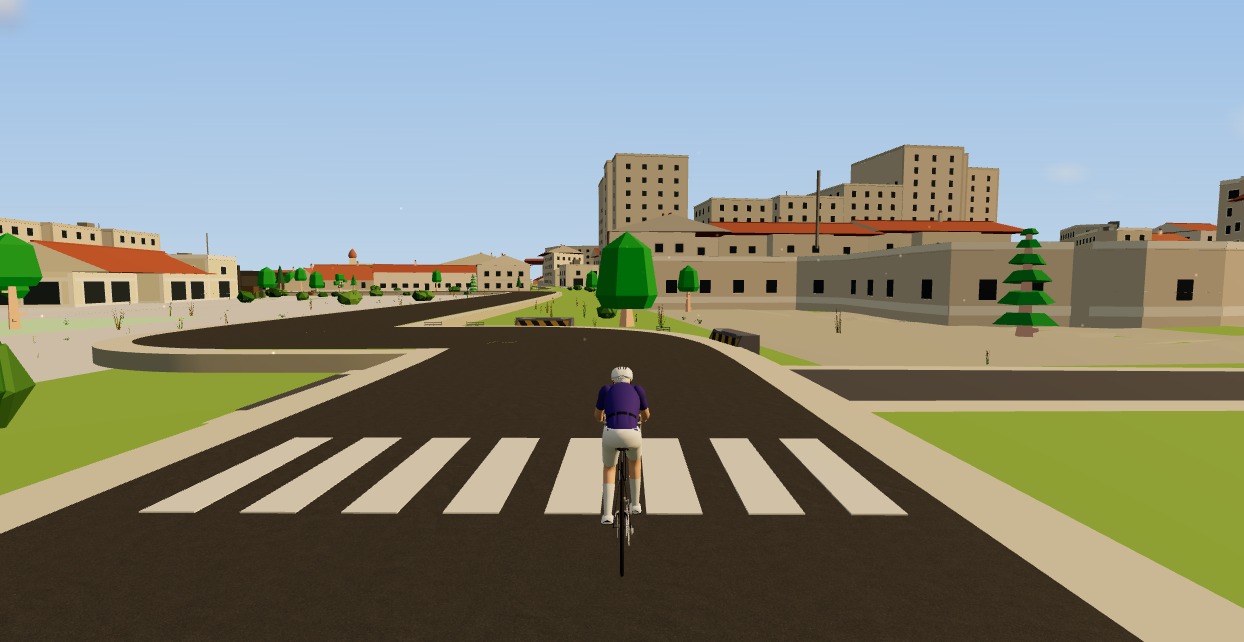
If you are in the second group, the useful thing is for the world on screen to be somewhere real. Moveee Indoor rebuilds your own saved routes as 3D roads in a browser tab, with trainer resistance following the actual gradient — so a February session can be a climb you rode last summer, or one you are about to travel to. It runs in a tab on whatever screen you already have, including a TV with a browser, which removes the install step entirely.
Being able to point it at a real route is also what makes it useful rather than merely distracting — riding your target event's final 20 km, at the real steepness, is a better use of a Wednesday than any amount of scenery. Previewing a race course indoors covers that, and beating turbo trainer boredom covers the wider problem.
Small things that make a disproportionate difference
- Put the fan where it hits your chest and face, not your legs. It matters more than the screen — see pain cave setup.
- Leave it all set up. A session that needs assembling is a session you skip — the argument in bike storage and indoor space.
- Have the workout chosen before you get on. Deciding what to do while already pedalling wastes the first ten minutes and frequently produces an aimless hour.
- Keep the audio separate. Music or a podcast from a speaker, not from the same device running the session, so nothing interrupts mid-interval.
Sources 5
Where this article summarises a study, the study itself is linked — not a write-up of it.
- 1 Sommerich CM, Joines SMB, Psihogios JP Effects of Computer Monitor Viewing Angle and Related Factors on Strain, Performance, and Preference Outcomes · Human Factors · 2001
- 2 Rempel D, Willms K, Anshel J, Jaschinski W, Sheedy J The Effects of Visual Display Distance on Eye Accommodation, Head Posture, and Vision and Neck Symptoms · Human Factors · 2007
- 3 Office Ergonomics: Positioning the Monitor · Canadian Centre for Occupational Health and Safety · 2024
- 4 Saunders AG, Dugas JP, Tucker R, Lambert MI, Noakes TD The effects of different air velocities on heat storage and body temperature in humans cycling in a hot, humid environment · Acta Physiologica Scandinavica · 2005
- 5 Baker LB Physiology of sweat gland function: The roles of sweating and sweat composition in human health · Temperature · 2019
Your own roads, indoors, in a browser tab
Moveee Indoor pairs your smart trainer over Bluetooth and rebuilds a route you have saved as a 3D road — real gradients, ERG for the intervals, and the ride saved with full power data. Nothing to install. Free while it is in alpha.
Start an indoor rideKeep reading
How to stop hating the turbo: 12 ways to beat trainer boredom
The trainer isn't boring because it's indoors — it's boring because of how most people use it. Twelve fixes, from session design to what's on the screen in front of you.

Indoor cycling on a Chromebook: the trainer apps that actually work
A Chromebook can't install Zwift — but it can still run a full trainer session. Here's how to ride indoors on Chrome OS with nothing to download, and exactly what you need.

A free app for the Zwift Hub and Zwift Ride (yes, without Zwift)
Zwift's own trainers speak the same standard Bluetooth as everyone else's — which means a Zwift Hub or Zwift Ride works perfectly well without a Zwift subscription. How to pair Zwift hardware with a free browser app, what works (ERG, resistance, power), and the honest caveats around buttons and firmware.
The best free Zwift alternative in 2026
Zwift is no longer the only game in town, and some of the best options cost nothing. Here's an honest guide to the best free Zwift alternative in 2026 — what each one does well, and how to pick the one that fits how you ride.

How to wash a bike without wrecking it
There are two or three ways to clean a bike that cause more damage than the dirt would have — and they are the ones that feel most satisfying. Fifteen minutes, in the right order, without contaminating your brakes.

No gaming PC needed: virtual cycling on the laptop you already own
Zwift's system requirements quietly rule out a lot of laptops. A browser-rendered world doesn't. Here's how to get a real virtual ride out of ordinary, years-old hardware.

Looking after a smart trainer
Most of what goes wrong with trainers is not wear — it is sweat, and the drivetrain attached to them. Diagnosing the noise (it is usually not the trainer), what the neighbours actually hear, and a maintenance schedule that takes minutes.

Flying with a bike: boxes, airlines and what gets damaged
The rear derailleur hanger is the part that breaks, the CO2 canisters are what get confiscated, and the airline's policy is never where you expect it. Packing so the bike survives, and reassembly checks before you ride away from the airport.
Disc brake noise: what it means and what to do
Better than rim brakes in nearly every way that matters and worse in exactly one — when they are unhappy they tell you loudly, in front of other people. Diagnosis by sound, the five-minute alignment fix, and the one noise that means stop riding.

Shoes and cleats: fit first, everything else after
The only part of a bike you wear, and the contact point riders think about least until something hurts. What actually matters in a shoe, the width point nobody mentions, and how to move a cleat without creating a knee problem.

Your first road bike: what to spend and what to ignore
Fit first, then contact points, then a certified helmet. Honest price bands, the spec-sheet numbers that do not matter, and the safety checks that do.
Sprint work for riders who are not sprinters
Most amateur plans have a hole at the top end, usually because the rider decided they are not a sprinter. Four sessions, why the rests are far longer than feels reasonable, and the one setting you must turn off to do these indoors.