
The Moveee team
Free coaching · a real route for every ride
Cycling is one of the best tools there is for losing weight sustainably. It's low-impact so you can do a lot of it without wrecking your knees, it scales from fifteen minutes to five hours, and — unlike most exercise prescribed for weight loss — it's genuinely enjoyable, which is the only reason anyone keeps doing anything for long enough to see a result.
It's also widely misunderstood. Riders regularly train hard for months and see the scale refuse to move. Here's what actually works, and the traps that catch almost everyone.
Riding creates the opportunity for a calorie deficit. It does not create the deficit. Plenty of people ride 200 km a week and don't lose a gram, because appetite rises to meet the training and they eat it all back — usually without noticing. If weight loss is the goal, the bike is half the equation at most.
Roughly what you burn
Energy burned on the bike tracks your power output and the time you spend producing it. The table below is for a rider of around 75 kg; scale it up or down with your own mass, and treat every figure as a broad estimate rather than a measurement — individual variation is large.
| Effort | Typical power | Rough burn | Notes |
|---|---|---|---|
| Easy spin (Z1–low Z2) | ~120 W | ≈ 430 / hr | Conversational. The pace you can hold all day. |
| Steady endurance (Z2) | ~160 W | ≈ 575 / hr | The workhorse pace — and the one most worth building your week around. |
| Tempo (Z3) | ~200 W | ≈ 720 / hr | Comfortably hard. Sustainable for an hour or two. |
| Threshold (Z4) | ~250 W | ≈ 900 / hr | Hard. Rarely sustainable long enough to dominate weekly totals. |
Look at those numbers and one thing jumps out: the difference between an easy hour and a threshold hour is real, but it isn't enormous — and you can do far more easy hours. Time on the bike, not intensity, is what moves weekly energy expenditure.

Six things that actually matter
You cannot outride a bad diet
An hour of steady riding burns roughly what's in a large muffin and a latte. Riding creates the deficit; what you eat decides whether it survives contact with the kitchen.
Long and easy beats short and brutal
Total energy burned is mostly a function of time. A relaxed three-hour ride out-burns a savage 45-minute interval session comfortably — and you recover from it faster.
Don't over-fuel the easy rides
A gel and a sports drink on a gentle 90-minute Z2 ride can replace most of what you just burned. Fuel hard sessions properly; fuel easy ones with water and sense.
Muscle you keep is muscle that burns
Losing weight fast usually means losing muscle too, which lowers your resting metabolism and your power. Lift twice a week and keep protein high to protect it.
Consistency beats intensity
Five hours a week for six months does far more than twelve hours a week for three weeks followed by burnout. Pick a load you can genuinely repeat.
Weight isn't the only scoreboard
Watts per kilo, how you feel on a climb and how your clothes fit are all better signals than a single morning number that swings 1–2 kg on hydration alone.
A sensible weekly shape
If losing weight is your main goal, build the week around volume you can repeat rather than sessions that flatten you:
- Three to four rides a week, most of them easy enough to hold a conversation.
- One longer ride — 2 hours upward, extended gradually. This is where the bulk of your weekly energy goes.
- One harder session, for fitness rather than calories. Fitness means you can ride longer, which means you burn more.
- Two short gym sessions to protect muscle — see strength training for cyclists.
- Fuel the hard rides, not the easy ones. Water on a gentle 90 minutes; carbs when the session actually demands them.

Where indoor riding helps more than you'd think
Weight loss is a consistency game, and the biggest threat to consistency is anything that gives you a reason not to ride — dark evenings, rain, no time to get out and back. The trainer removes all of them. A guaranteed hour, at a controlled intensity, no matter the weather, is worth more to a weight-loss goal than a heroic weekend ride you manage twice a month.
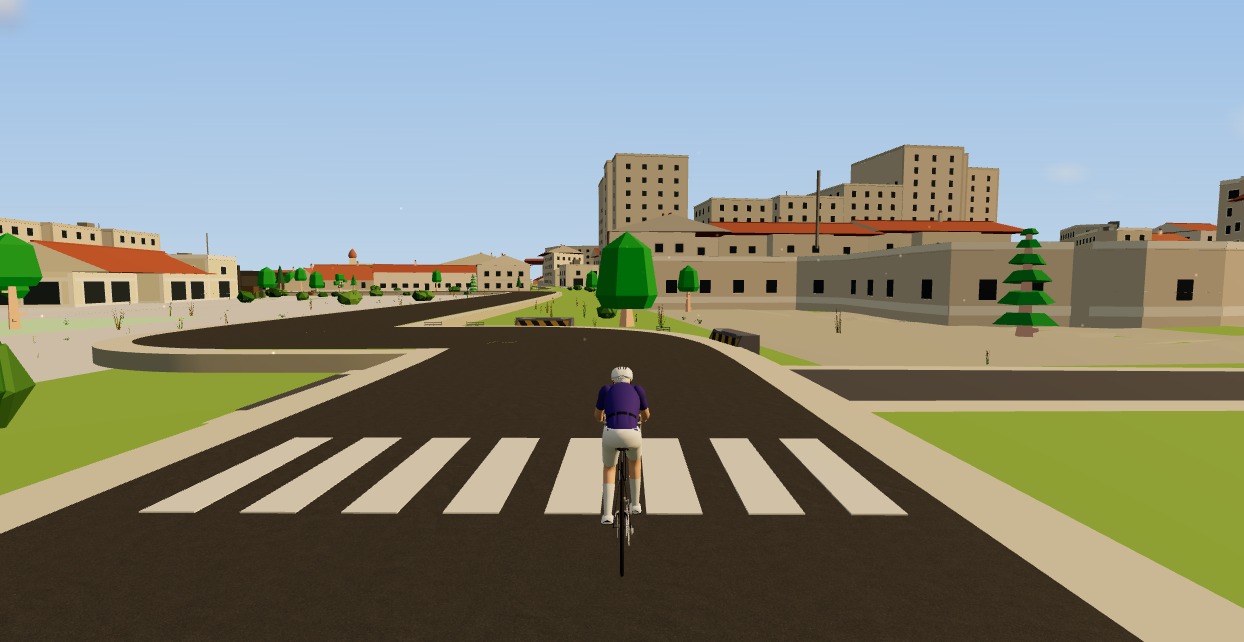
Indoor hours are also more energy-dense per minute: no coasting, no traffic lights, no freewheeling downhill. The catch is boredom, which is why it helps to have somewhere to look. Moveee Indoor renders your own saved routes in 3D from real map data, so a steady endurance hour happens on roads you actually know rather than in front of a wall. It runs in your browser, holds structured targets in ERG mode, and it's free while in alpha — and every ride lands in your Moveee log with full power data, so you can see the weekly volume adding up.
Give it months, not weeks
Sustainable change on the bike shows up over a season, not a fortnight. Ride often, ride mostly easy, lift a bit, don't drink your calories back, and judge progress by how you feel on a long climb in June rather than by the scale on a Tuesday in February. That's genuinely the whole method.
Sources 5
Where this article summarises a study, the study itself is linked — not a write-up of it.
- 1 Ettema G, Lorås HW Efficiency in cycling: a review · European Journal of Applied Physiology · 2009
- 2 Donnelly JE, Blair SN, Jakicic JM, Manore MM, Rankin JW, Smith BK American College of Sports Medicine Position Stand: Appropriate Physical Activity Intervention Strategies for Weight Loss and Prevention of Weight Regain for Adults · Medicine & Science in Sports & Exercise · 2009
- 3 King NA, Hopkins M, Caudwell P, Stubbs RJ, Blundell JE Individual variability following 12 weeks of supervised exercise: identification and characterization of compensation for exercise-induced weight loss · International Journal of Obesity · 2008
- 4 Longland TM, Oikawa SY, Mitchell CJ, Devries MC, Phillips SM Higher compared with lower dietary protein during an energy deficit combined with intense exercise promotes greater lean mass gain and fat mass loss: a randomized trial · The American Journal of Clinical Nutrition · 2016
- 5 Bhutani S, Kahn E, Tasali E, Schoeller DA Composition of two-week change in body weight under unrestricted free-living conditions · Physiological Reports · 2017
See this in your own numbers
Moveee builds your power curve, fitness and fatigue from every ride you upload, and writes a training plan around them. It is free, it takes one Strava connection, and it will tell you more about your riding in a week than any article can.
Start freeKeep reading

What riding a bike actually does for your health
No wall of dubious percentages — just an honest look at what regular riding does for your heart, joints, weight, mind and sleep, the two real caveats, and how much you actually need.

Commuting by bike: how to make it count as training
Riding to work has some of the strongest health evidence in all of cycling. How to turn thirty minutes each way into genuine training, when to keep it easy instead, and the logistics that make it sustainable.

How to get back on the bike after a break (or an injury)
The hard part isn't the fitness, it's the arithmetic of not chasing your old numbers. What to expect in the first four weeks, how to build load without breaking something, and where a clinician's plan beats any article.

Zwift on iPad? A browser alternative for tablets that actually works
Searching for Zwift on iPad — or a lighter tablet alternative? Here's the honest state of indoor cycling on tablets in 2026: what works on an Android tablet in the browser, the real iPad Bluetooth catch, and the simplest setups that just work.

No gaming PC needed: virtual cycling on the laptop you already own
Zwift's system requirements quietly rule out a lot of laptops. A browser-rendered world doesn't. Here's how to get a real virtual ride out of ordinary, years-old hardware.

A free app for Saris and JetBlack trainers (in your browser)
A Saris H3 or a JetBlack Volt doesn't need a subscription to earn its keep — both brands speak standard Bluetooth FTMS, so a browser tab can control resistance, hold ERG targets and record the ride. Model-by-model support, pairing steps, and the honest caveats for older wheel-on units.

How to use your Wahoo KICKR without Zwift (a free browser app)
Your Wahoo KICKR doesn't need Zwift — or any subscription — to give you a proper session. Here's how to use a KICKR (or KICKR Core, Snap and Move) with a free browser app that controls resistance, holds ERG targets and saves to Strava.
No ERG mode? How to use your gears as the resistance dial on a dumb trainer
How to run a structured indoor session with no power and no ERG — the way everyone did it until about 2015. Four sessions that work, how to steer by heart rate despite its lag and drift, and the one caveat about your training plan.

The one setting that decides if your speed is right inside the cycling app
A speed sensor counts wheel revolutions, not kilometres. Get the tyre circumference wrong and every number is wrong by the same percentage — up to 10% — while looking entirely plausible. The table, and the two-minute roll-out that beats it.

The screen in front of your trainer
Riders spend a fortune on trainers and nothing on what they look at, then wonder why an hour indoors feels longer than three outside. It is an ergonomics problem before it is a hardware one — and sweat is the part that kills laptops.

Choosing a bike computer: what actually matters
Easy to overspend on capabilities you will never use, equally easy to buy the cheapest and be quietly annoyed for three years. Three tiers described honestly, the five specifications that matter, and the feature set that is mostly marketing.
The off-season: how long to rest and what to keep doing
Two to four weeks of light, unstructured riding, one short hard session kept, and not past six. The detraining studies say what you lose, how fast, and which losses are cheap.